The best moment to look at this scene is not during the work. It is the first minute after the chime, before you pick up your phone.
🌸 Name what you're studying
25:00
 Written by Dr. Leo Maren · Co-founder of Fwocus · Behavioural scientist · PhD, Imperial College London
The best moment to look at this scene is not during the work. It is the first minute after the chime, before you pick up your phone.
In 2015, Kate Lee and colleagues at the University of Melbourne gave 150 university students a long, dull attention task. Halfway through, each student saw a city rooftop for 40 seconds. For half of them, the roof was covered in a flowering meadow. For the other half, it was bare concrete.
After the flowering roof, students made fewer errors of omission, which means they missed fewer of the moments when they had to respond. Their responses were also more consistent. Earlier studies had found effects of nature after minutes or hours, not seconds.
The study showed photos of a flowering roof, not cherry blossoms. It measured one attention task right after the break, in one lab. It does not show that a sakura background helps you study for an hour.
What I take from it is a habit, not a promise. When the chime plays, I keep my eyes on the scene for about 40 seconds before I do anything else. It is a small pause, and it replaces the phone check that usually fills that gap.
The scene is Sakura Blossom Street in golden-hour light. Old wooden houses stand on the left. On the right, cherry trees in full pink bloom line a canal, and petals cover the road and float on the water. A commuter train crosses a bridge in the middle, with mountains behind it.
It is a light scene, so the digits are dark. They sit in front of the train and the bridge, the busiest part of the picture. The large digits stay clear, but the small length tabs above them are harder to read here than on a plain scene.
A cherry tree is usually at its best for only about a week or two each spring. If there are real blossoms near you during that time, take your long break under them. A walk outside does more than a picture on a screen, and the scene will still be here when you come back.
I learned this late. For two springs during my PhD, I studied through the whole blossom season. My desk was a short walk from a park full of cherry trees. Now I plan one long break outside on each day of peak bloom, and I use this scene for the rest of the year.
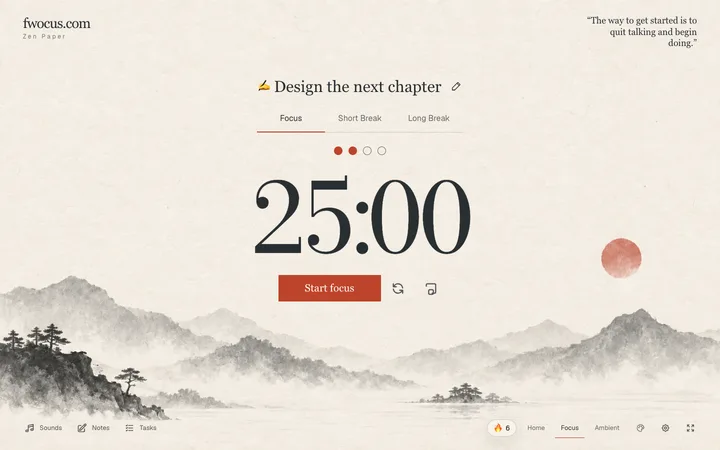
For a quieter spring scene with more empty space behind the timer, the Fwocus app has Plum Blossom. It is an ink painting of a plum branch over misty hills on pale paper. Plum trees flower in late winter, before the cherry trees. In Japan, the plum blossom marks the end of winter, and the cherry blossom marks spring and the start of the school year in April.
Sakura Blossom Street is one of more than 60 scenes in the Fwocus app. In the app, you can change the scene and save your sessions, with tasks, notes, focus stats and your streak next to the timer.
Yes. The scene and the timer do not change with the season. I like a spring scene most in winter, when the days outside are short and grey.
No. The page plays a short bell when you press Start and a chime at zero. The Fwocus app has ambient sounds that you can add to any scene.