Written by Dr. Leo Maren · Co-founder of Fwocus · Behavioural scientist · PhD, Imperial College London
Breaks sized by the work, not the clock
Flowmodoro has one rule. Work in a single unbroken block until you feel your focus fading. Then rest for one-fifth of the time you worked.
A 90-minute block earns an 18-minute break. A 40-minute block earns 8 minutes. The rest is proportional to the effort, not fixed by a schedule.
Compare this with Pomodoro. It gives the same five-minute break after every 25 minutes, whether you worked deeply or drifted. Flowmodoro rewards depth: the deeper the block, the longer the rest.
I was skeptical of the one-fifth ratio. It sounded like numerology dressed as method. So I ran it on paper for two weeks, dividing each block by five with a calculator.
Long deep blocks earned real rests. Short shallow blocks earned short ones. I stopped skipping breaks entirely, because an earned break feels deserved in a way a scheduled one never did.
The mechanism is simple. Fixed breaks create a negotiation: you feel tired at minute 18 and start watching the clock. Proportional breaks remove the negotiation. The block decides the rest, and the block is already over.
A method with no planned end needs count-up
You cannot run Flowmodoro on a countdown. A countdown needs a target, and Flowmodoro has none. The block ends when focus fades, which no one can schedule.
Count-up fits because it measures what happened. Start the stopwatch with Space and work. When you stop, the display holds the exact block length.
Divide the final time by five and you have your break. No app, no settings, no configuration. The arithmetic is the method.
This is why the tool on this page is a stopwatch, not a Pomodoro timer. A Pomodoro countdown would force the one decision Flowmodoro exists to remove: how long will this take?
The failure mode: quitting before focus actually fades
The most common failure is stopping too early. Years of Pomodoro training teach the body that 25 minutes means stop. Restlessness at minute 26 gets misread as fading focus.
There is a difference between discomfort and fading. Discomfort is the urge to check your phone. Fading is rereading the same paragraph three times and retaining nothing.
For my first week I kept stopping at thirty minutes. Every block landed between 28 and 32 minutes, which told me it was habit, not fatigue. I started asking one question before stopping: can I still think clearly? The answer was usually yes, and the blocks stretched to fifty minutes and beyond.
Do not swing to the other extreme. Working through genuine fading does not build stamina. It builds errors and resentment. Stop when thinking gets sloppy, not when the chair gets uncomfortable.
What your block lengths teach you
Log two numbers only: the block and the break. Time and break length are enough. After two weeks a pattern appears.
I learned more from the log than from the method. My morning blocks averaged 68 minutes. My Friday afternoon blocks averaged 24.
The method did not change. My brain did. Now hard problems go before lunch and admin goes to Friday.
Treat the log as personal data, not evidence. It tells you about your rhythm. It says nothing about anyone else's.
Running a Flowmodoro day on this page
Choose one task for the block. One task, not three. Start with Space and put the phone in another room.
Work until focus fades. Stop the timer and divide by five. A 55-minute block earns an 11-minute break.
Spend the break away from the screen. Walk, stretch, make tea. Do not spend the break on your phone. A phone break is not rest; it is a different kind of work.
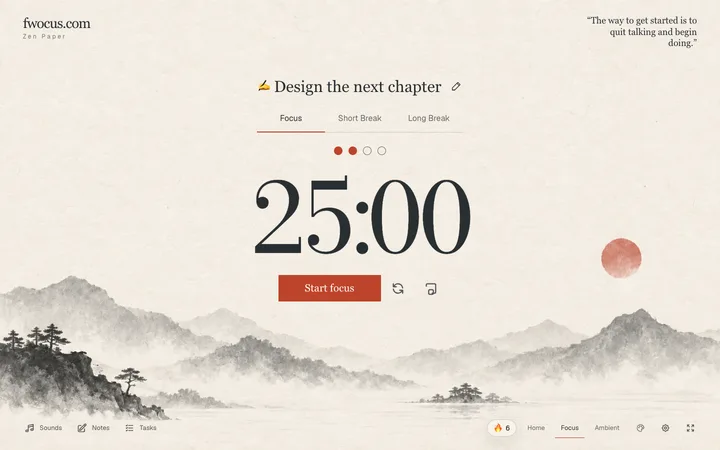
Press R to reset, then start the next block. The Zen Paper theme keeps the display calm across a full day, and the soft chime marks each start and stop without breaking your state.
If you want the fixed-interval alternative for comparison, the Fwocus app (https://app.fwocus.com/) runs structured Pomodoro countdowns. Use it as the control group for your own experiment.
FAQ
What is the Flowmodoro technique?
Work in one unbroken block until you feel your focus fading, then rest for one-fifth of the time you worked. A 60-minute block earns a 12-minute break. There are no fixed intervals and no alarms cutting your work short.
Why does Flowmodoro need a count-up timer instead of a countdown?
A countdown requires a planned end time, and Flowmodoro blocks have no planned end. Count-up measures the block as it happens, so you can divide the real length by five. A Pomodoro countdown forces the one decision the method removes.
How do I know when my focus has actually faded?
Fading shows up as sloppy thinking: rereading without retaining, slow decisions, a rising error rate. That is different from discomfort, which is just the urge to check your phone. When in doubt, ask whether you can still think clearly.
Does Flowmodoro work for shallow tasks like email?
It works, but the method shines in deep work. Short shallow blocks produce trivially short breaks, and the ritual outweighs the gain. For admin batches, fixed intervals or a simple task list usually serve better.