Written by Dr. Leo Maren · Co-founder of Fwocus · Behavioural scientist · PhD, Imperial College London
Is night a good time for you to study?
It depends on your chronotype, which is your natural preference for mornings or evenings. For some people, night is their best time to think. For others, it is the worst. The useful question is not "Is night good for studying?" but "Is night good for me, and for which tasks?"
In 1993, May, Hasher and Stoltzfus gave a standard questionnaire on morning and evening preference to younger and older adults. Most younger adults were evening types or neither type. Most older adults were morning types. Then they tested memory at different times of day. In the late afternoon, the younger group's better time, the younger adults did much better than the older adults. In the morning, the older group's better time, the gap was gone.
The authors called the key factor synchrony: a match between your peak time and the time of the task. A 2007 review by Schmidt and colleagues found the same pattern across many studies of attention, memory and planning tasks. Performance changes across the day, and the change depends on your chronotype.
What the research does not show is that night is a good or bad time for everyone. It shows that the answer is personal. If you do not know your type, watch yourself for a week. Notice when hard problems feel easiest.
Match the task to the hour
Here is the part that surprised me. Your off-peak time is not useless. It is good for a different kind of thinking.
In 2011, Wieth and Zacks gave students two kinds of problems at their best time of day or their worst. Analytic problems are solved step by step. Insight problems need a new way to see the problem. The students solved more insight problems at their worst time of day. For analytic problems, time of day had no consistent effect.
The researchers think lower mental control at off-peak times lets more unusual ideas through. What the study does not show is that you should do your exam revision at your worst hour. Insight puzzles are not the same as a page of past papers.
I am an evening type. During my PhD, I did my analytic work after 9 p.m., and it went well. But my best ideas about how to structure a chapter often came on slow mornings, when I felt I was doing nothing useful. I thought that was luck until I read this study.
This is how I would plan night study now:
If night is your peak: use it for analytic work. Problem sets, proofs, memorizing and close reading go here. Save the morning for open questions.
If you are a morning type and must study at night: use the night for open tasks. Brainstorm essay ideas, draw a concept map, or review notes you already know. Do the hard problem set the next morning.
Decide the last block before the first one
A night session has no natural end. Nothing closes, and nobody comes to turn off the lights. One more block becomes three more blocks, and tomorrow still starts at the same time.
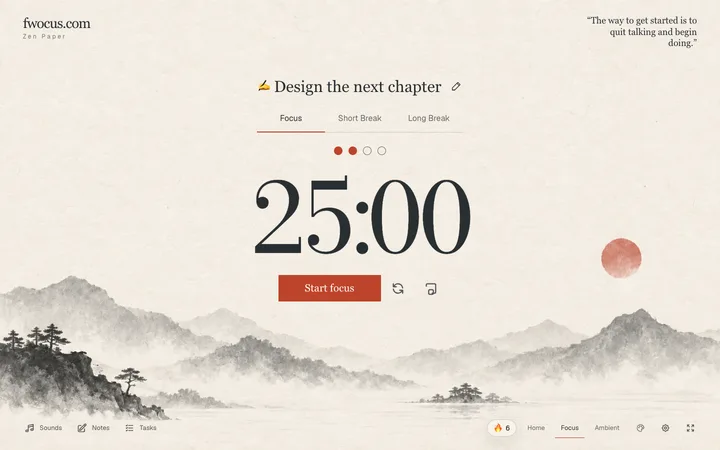
So I decide the end before I start. I write the stop time in the line above the timer, next to the task: "Stats problems 4.1 to 4.6, stop at 23:30." Then I count back. Four 25-minute blocks with three 5-minute breaks take 1 hour and 55 minutes.
The timer helps with this. After the fourth block, it changes to the 15-minute long break, but it does not start the break by itself. At night, I treat that moment as the end of the session. If I want to continue, I must make a new decision. Most nights, I stop.
If 25-minute blocks feel too short for one long problem, use the 50 minute timer for one long countdown. The rule about the stop time still applies.
A dark scene for a dark room
In a dark room, a white web page is the brightest thing you can see. This scene is mostly deep blue, with small warm lights in the windows and on the water. The timer digits are light on a dark background.
Two small changes make the screen calmer at night. Press F for full screen, so the browser bar and tabs go away. Then turn down the brightness of your screen until the scene looks like a picture, not a lamp.
If you want company late at night, a night study with me video gives you a person at a desk. This page gives you the night room and a timer that you control, without a video.
Lantern Canal is one of 60+ scenes
The scene on this page is Lantern Canal: a quiet canal in an old town after sunset. Stone houses with flowers and lamps line the water, a stone bridge crosses it, and a church tower stands on the hill behind. It is a still image, so nothing on it moves.
The Fwocus app has more than 60 scenes in five themes. In the app, you can change the scene, set your own session lengths, keep tasks and notes next to the timer, and see your focus history and streak.
FAQ
Is this a night timer for lights or outlets?
No. This is a study timer in your browser. It does not control lights, outlets or other devices.
Will the chime wake other people?
The chime is short and soft, and it plays at your device's volume. At night, lower the volume or use headphones. If you want no sound at all, the silent timer is a countdown with no sound.
Does the scene get darker as the night goes on?
No. It is one still picture of a canal at night. It looks the same at 9 p.m. and at 2 a.m.
Can I change the 25-minute focus length?
Not on this page. It uses 25-minute focus blocks, 5-minute short breaks and a 15-minute long break. In the Fwocus app, you can set every length yourself.