Written by Dr. Leo Maren · Co-founder of Fwocus · Behavioural scientist · PhD, Imperial College London
This page runs 50/10 as a full cycle. When a 50-minute block ends, the timer moves to a 10-minute break. When the break ends, it moves back to focus. After the fourth focus block, it offers a 30-minute long break instead. You decide when each part starts, but you never have to set the next length yourself.
If you only want one 50-minute block, the 50 minute timer is simpler. It counts down once and stops. Use this page when you plan to study for several hours and want the breaks to keep their shape.
What a full 50/10 cycle looks like
A full cycle is four focus blocks, three short breaks and one long break:
Focus 50 · Break 10
Focus 50 · Break 10
Focus 50 · Break 10
Focus 50 · Long break 30
That is 200 minutes of focus inside 4 hours and 20 minutes. The four dots under the tabs fill as each focus block reaches zero. A block you reset before the chime does not count.
You do not need to finish a cycle. Two blocks with one break make a solid revision session of just under two hours. The cycle is a ceiling, not a target.
One detail made the cycle easy for me to keep. If I start the first block at 9:00, the long break begins at 12:50. It falls exactly where lunch would be. On days when I start at 9:00, I do not plan lunch at all. The timer plans it for me.
Fixed breaks, or breaks when you feel tired?
Many students prefer to break "when they need to." The best study I know on this question points the other way.
Biwer and colleagues (2023) followed 87 Dutch university students through one real study day. One group took breaks whenever they chose. Two groups took fixed breaks: 6 minutes after every 24 minutes, or 3 minutes after every 12. The students who chose their own breaks studied in longer stretches and took longer breaks. They also reported more fatigue and distraction, and less concentration and motivation. All three groups finished about the same amount of work.
What this shows: in a real study day, fixed breaks felt better and did not cost output. What it does not show: anything about 50/10 itself. The fixed schedules in the study were 24/6 and 12/3. It was also one day, and the outcomes were mostly the students' own ratings.
My experience agrees with the direction. On days without a timer, I believed I would notice when I needed a break. In practice, I noticed late. I worked through the morning without a stop and then lost the first hour of the afternoon to slow, scattered reading. A fixed break arrives before I notice that I need it. That is the point of it.
Why the long break is 30 minutes
The 10-minute breaks interrupt a block. The long break resets a session. After three hours of focus, a short pause is often not enough to start the next block well.
The clearest evidence I know comes from schools, not from study timers. Sievertsen, Gino and Piovesan (2016) looked at national tests taken by children in Danish public schools. For every hour later in the school day that a test took place, scores were a little lower: 0.9% of a standard deviation. When the test came right after a 20- to 30-minute break, scores were higher by 1.7% of a standard deviation.
These effects are small for one student on one day. The study did not test university students, and it did not test self-study at home. It does suggest two things that apply here. Performance on mental work drops over a day of sustained effort. A break of 20 to 30 minutes can bring some of it back.
So when the timer offers the long break, take all 30 minutes. Eat, go outside, or talk to someone. On the days I skipped it, the block after it was my weakest of the day.
Stretch or skip a part of the cycle
The tabs let you move through the cycle by hand. Click Focus to skip a break, Short Break to take an early one, or Long Break when you want the 30 minutes now. Each tab loads its full length and waits for you to press start.
Use this freedom rarely. If you skip breaks often, a fixed cycle is the wrong tool for that task. When the chime keeps cutting you off in the middle of good work, try the Flowmodoro timer, where the length of your focus sets the length of your break. When 50 minutes feels too long to start, the aesthetic timer runs the standard 25/5 Pomodoro.
Fern Conservatory, one of 60+ scenes
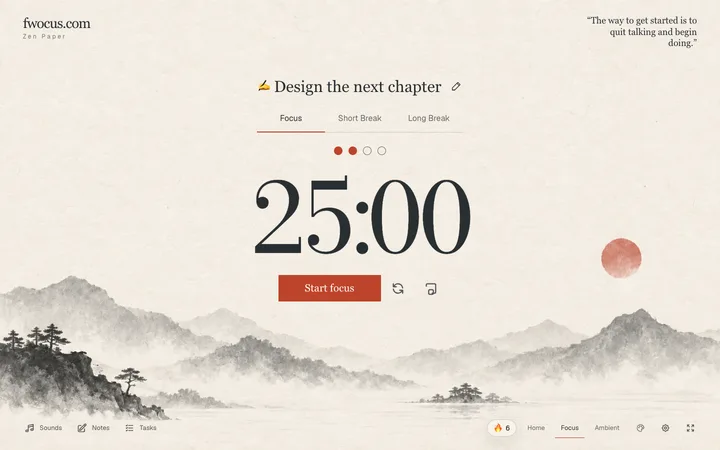
The background is Fern Conservatory: pale green watercolor paper with ferns, leaves and small white flowers in the two lower corners. The middle of the picture is open, so the digits stand on a calm, even color. It is a still picture.
Fern Conservatory is one of the 60+ scenes in the Fwocus app. In the app, you can change the scene, set your own focus and break lengths, keep tasks and notes next to the timer, and see your focus history and streak across a whole week of 50/10 days.
FAQ
Does the break start automatically?
No. When a block reaches zero, you hear a chime and the next tab is selected for you, with its full length loaded. Nothing runs until you press the button.
Can I change 50/10 to 45/15 or another split?
Not on this page. The lengths here are fixed at 50, 10 and 30 minutes. The Fwocus app lets you choose your own focus, break and long-break lengths.
What happens to the cycle if I reset a block?
Reset returns the current block to its full length. The cycle dots count only focus blocks that reach zero, so a reset block does not move you toward the long break.
Can I use the keyboard?
Yes. Space starts and pauses the current block, R resets it, and F opens fullscreen. The countdown follows an end time, so it stays correct when you switch to another browser tab, and the tab title shows the time left.