Written by Dr. Leo Maren · Co-founder of Fwocus · Behavioural scientist · PhD, Imperial College London
Active recall means you take information out of memory instead of putting it in again. You answer a question before you look at the answer. You explain a process with the book closed. You work a problem without the worked example next to it. Researchers call it retrieval practice, and the benefit it produces the testing effect.
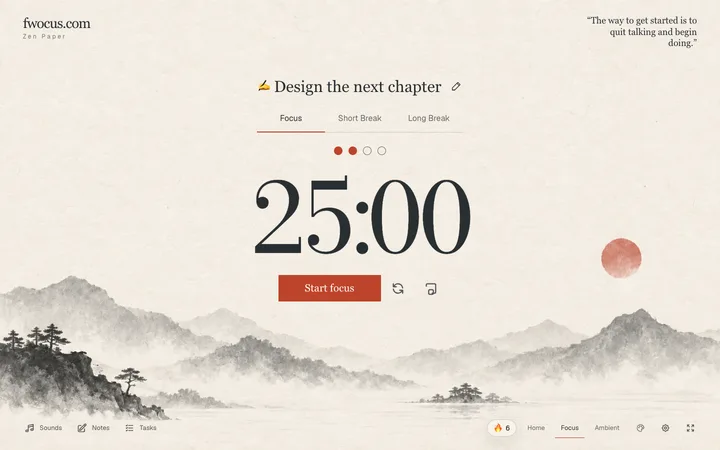
The timer above runs one round: 10 minutes of recall, 5 minutes to review your answers against the source, and 5 minutes of rest. The rest of this page is about the part a timer cannot do for you: what to recall, and how to tell if it works.
Rereading feels better and works worse a week later
The classic study is Roediger and Karpicke (2006). In their second experiment, 180 students learned a short passage of under 300 words, on the sun or on sea otters. One group read it in four 5-minute periods. Another group read it once, then took three 10-minute recall tests on a blank sheet.
Five minutes later, the reading group remembered more: 83% of the ideas, against 71% for the recall group. One week later, the result reversed. The reading group remembered 40%. The recall group remembered 61%, even though it had read the passage far fewer times.
The reading group also felt more confident that it would remember the passage in a week. That is the trap. Rereading makes a text feel familiar, and familiar feels like learned.
What the study does not show: that this holds for every subject and every kind of exam. The passages were short, and the final test was the same kind of free recall the students had practiced. What it does show is useful for planning. If your exam is in an hour, rereading is fine. If it is in a week or more, recall wins.
The Recall preset matches the 10-minute recall tests in that study. It is a reasonable length for one topic, not a magic number.
Write the questions before the Recall block
Active recall needs a prompt. Without one, "test yourself" turns into "look at the notes and nod." Spend a few minutes before the first round writing questions. Keep the answers on a separate page, or on the back of a card.
One idea per question. "What are the stages of mitosis?" asks for a list. "What happens to the chromosomes in anaphase?" asks for one idea you can check.
Ask why and how, not only what. "Why does the enzyme stop working above 60 °C?" makes you rebuild the explanation. A definition question only checks a phrase.
Use your headings. Each heading in your notes can become one or two questions. This takes less time than it sounds.
Mix in problems. For math, physics or chemistry, a problem without the worked solution is the best question there is.
During my PhD, I made question lists for the papers I needed to know well. My first lists were almost all definitions. I could answer every one, and I still could not explain how the papers connected. When I changed to "why" and "what would happen if" questions, the lists became shorter and much harder. That was the point at which they started to work.
Run a round with the three presets
Write the topic on the line above the timer. Then:
Recall · 10 min. Answer the questions from memory, in writing or out loud. Do not look at the notes. Leave a blank where you cannot answer and move on.
Review · 5 min. Click the Review tab and open the source. Mark each answer right, partly right, or wrong. Reread only the parts behind the wrong and blank answers.
Rest · 5 min. Click the Rest tab and leave the desk. The rest also puts a few minutes between your review and the next round, so the next recall tests your memory, not what you read a moment ago.
Each step needs one click. When a chime plays, the countdown stops at zero and stays there until you choose the next tab.
Keep testing what you already know
The most common mistake in active recall is to drop a question as soon as you answer it correctly once. It feels efficient. The evidence says it is not.
Karpicke and Roediger (2008) taught students 40 Swahili–English word pairs. In some conditions, a pair stopped being tested after the student recalled it once. In others, every pair kept being tested. By the end of learning, all groups had recalled almost every pair at least once. One week later, the groups that kept testing recalled about 80% of the pairs. The groups that dropped recalled pairs from testing recalled 33% and 36%.
The students' own predictions did not show this difference. They could not tell from the inside which method worked better.
In practice: keep a question in the next round even if you got it right. I only retire a question when I answer it correctly in rounds on different days. Flashcard apps that hide a card after one correct answer work against this.
How strong is the evidence for active recall?
It is strong, by the standards of education research. Adesope, Trevisan and Sundararajan (2017) combined 118 articles with about 15,000 participants. Practice tests produced more learning than restudying and every other comparison condition they examined. In a 2013 review of ten common study techniques, Dunlosky and colleagues gave practice testing their highest rating for usefulness. They gave rereading and highlighting low ratings.
The limits are real too. Many studies used short materials and tests a few days or weeks later. The size of the benefit changes with the test format, the delay and the material. And "active recall" is a name from the study community, not a separate method. It is the same retrieval practice the research describes.
If you want to check yourself under exam conditions after a few rounds, time a full past paper with the exam practice stopwatch. For long revision blocks without the three steps, the aesthetic timer runs Pomodoro cycles.
Rain Pavilion, one of 60+ scenes
The background is Rain Pavilion: an ink-wash lake on cream paper, a small pavilion under trees, a red sun in the mist, and reeds in the foreground. Most of the picture is open paper, so the timer and the topic line stay easy to read. It is a still picture.
Rain Pavilion is also in the Fwocus app, together with more than 60 other scenes. In the app, you can change the scene, keep your question lists in notes next to the timer, save your sessions, and see your focus history and streak.
FAQ
What is the difference between active recall and blurting?
Blurting is one form of active recall. In blurting, you write everything you remember about a topic on a blank page with no prompts. Active recall also includes answering specific questions, using flashcards, and solving problems without the solution.
Are flashcards active recall?
Only if you answer before you turn the card. Reading the front and back together is rereading. Say or write your answer first, then check.
How many rounds should I do?
Do rounds until most answers in the Recall block are right, then stop for the day. Come back to the same questions on another day. Late rounds on the same day feel productive, but the answers are still fresh, so they test your memory less.
Should I recall in writing or out loud?
Writing is slower but leaves a record you can check in the Review step. Saying answers out loud is faster and works well for definitions and vocabulary. For problems and long explanations, write. If you need more than 10 minutes, press + or the Up arrow while the Recall block runs.