Written by Dr. Leo Maren · Co-founder of Fwocus · Behavioural scientist · PhD, Imperial College London
Studying has no finish line, so stop timing it like a race
A countdown over a study session creates alarm anxiety. You watch time run out instead of watching understanding build. Attention is the resource that matters, and anxiety spends it.
A stopwatch reverses the frame. It measures what you have achieved, minute by minute, with nothing to run out of. The pressure moves to the right place: the work itself.
During my doctorate I set two-hour countdowns for thesis writing. I checked the remaining time constantly, as if the numbers falling would make the pages grow. They did not. The checking was a displacement activity dressed as time management.
I switched to count-up. The checking stopped within days, because there was nothing to run out of. Sessions felt longer in the good way. More got written. The only thing that changed was the direction the numbers moved.
Time past papers under exam conditions, then read the splits
Past papers are the highest-value study activity most students underuse. Doing them timed, under real conditions, is what converts practice into performance. The stopwatch makes the conditions real.
Start the timer when the exam would start. Press L at each section boundary. Work straight through with no phone, no notes, no pauses. When you finish, the lap list shows exactly where the minutes went.
When I prepared for my own exams, section two always ate the budget. Without splits I would have called it "running out of time" in general, which suggests a general fix like "write faster". The lap list was specific. One section type was slow. I drilled that section type for two weeks.
The next paper finished with ten minutes to spare. The fix was targeted because the measurement was targeted. Totals diagnose nothing. Section splits diagnose everything.
One caution. Do not time every study session like an exam. Timed papers are assessments. Daily study is training. Assess weekly, train daily, and keep the two modes separate.
Protect attention like the resource it is
Directed attention fatigues with use. This is one of the sturdier findings in attention research. After an hour of hard focus, the mind needs genuinely different input to recover, not just a different screen.
Structure study as blocks separated by real breaks. Work with the stopwatch running. Break with it paused. The timer records only work time, so breaks never pollute the measurement. An honest log of focused hours beats an inflated log of hours near a desk.
I used to take "breaks" scrolling my phone for ten minutes. I returned foggy and needed twenty minutes to refocus. The break had cost thirty minutes, not ten. I switched to window-and-tea breaks: look outside, drink something warm, no screen.
The fog lifted. The next block started clean. The stopwatch confirmed it indirectly: my productive hours per day rose while my desk hours stayed flat. Break quality shows up in the numbers, one block later.
Attention restoration needs distance from the task. A walk beats a feed. A window beats a walk to the kitchen with a podcast. The further the break stimulus is from study, the better the recovery.
Separate deep study from admin study
Not all study wants the same clock. Deep work, problem sets, writing, reading papers, has no natural alarm moment. You stop when the problem yields. Count-up respects that shape.
Admin study is different. Flashcards, organizing notes, clearing a problem backlog. These are short, bounded, slightly dull tasks. Fixed intervals with a defined end work better here. The Fwocus app covers those with Pomodoro sessions and ambient soundscapes.
Using one timing mode for both is a common mistake. Countdowns over deep work create anxiety without improving output. Open timing over admin tasks lets dull work sprawl. Match the clock to the task type.
My own split: mornings for deep count-up blocks, afternoons for timed admin bursts. The morning needs room to breathe. The afternoon needs a fence. The timer follows the work, not the other way around.
A quiet keyboard ritual for study
Space starts and pauses. L marks section splits in past papers. R resets. F toggles fullscreen for a display with nothing to fiddle with.
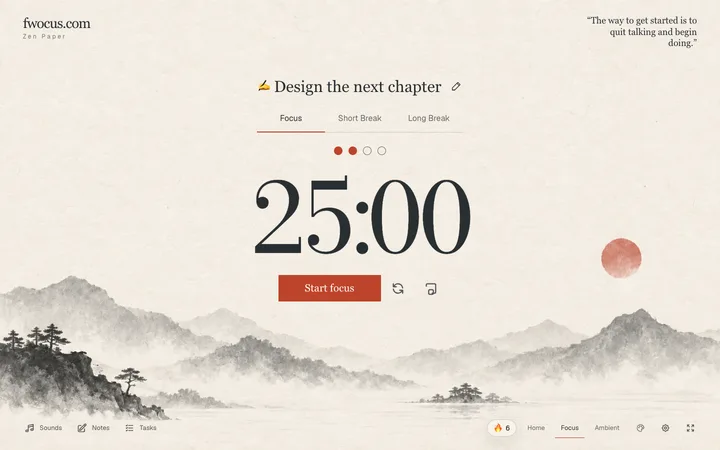
My study ritual: phone in another room, timer open, F for fullscreen, Zen Paper theme for long sessions, Space to begin. The soft chime confirms each section split without breaking focus. When the session ends, the log shows achieved hours, not survived countdowns.
Review the log weekly. Not to judge yourself, but to learn your rhythm. Most people discover their real deep-work capacity is three to four hours a day. That is normal. Plan around the truth and the truth starts cooperating.
FAQ
Is a stopwatch or a Pomodoro timer better for studying?
It depends on the task. Deep work with no natural endpoint suits count-up timing, which records achieved time without alarm anxiety. Short admin tasks like flashcards suit fixed Pomodoro intervals. Use each clock for what it fits.
How do I time a past paper with a stopwatch?
Start the timer when the exam would start, press L at each section boundary, and work straight through under real conditions. Afterwards the lap list shows where your minutes went, section by section.
How long should a study block be?
Attention varies by person and task, but fifty to ninety minutes is typical for deep work. Let the stopwatch reveal your real rhythm over a few weeks rather than imposing a number from a productivity book.
Does the timer distract while studying?
It should not. Count-up has no alarm to anticipate, so there is nothing to watch. Use fullscreen and the calm Zen Paper theme, run it from the keyboard, and check it only at natural breaks.