Written by Dr. Leo Maren · Co-founder of Fwocus · Behavioural scientist · PhD, Imperial College London
Reading speed is invisible until you time it
Readers guess their pace badly. A chapter that felt like twenty minutes took forty-five. A book "almost finished" needs another week. Without measurement, reading plans are wishes.
A quiet count-up reveals true pace without pressuring it. Time a few chapters, divide pages by hours, and you know your speed. Planning a book becomes arithmetic instead of hope.
I read a dense four-hundred-page history last winter. I assumed fifty pages an hour, my old novel pace. I timed three chapters with laps. Actual pace: twenty-eight pages an hour. My finish-by-Friday plan was fiction.
I replanned to twenty days at the measured pace and finished calmly, a day early. Nothing about my reading changed except the plan. The timer did not make me faster. It made me honest, and honesty finished the book.
Lap each chapter to find your real rhythm
Press L at every chapter end. The lap list becomes your pace profile across the book. Long chapters get their own sessions. Short ones batch together. The structure follows the measurement.
Pace varies with difficulty, and the lap list shows you where the book gets hard. That is information, not failure. Dense argument needs slower reading. Narrative moves fast. A flat pace across both means you are skimming one or crawling through the other.
I noticed this in a biography where laps showed chapters twelve through fourteen taking twice as long as the rest. I had been rereading paragraphs without registering that I was stuck on the author's argument. Once I saw the pattern, I slowed down deliberately for hard chapters instead of fighting them at narrative speed.
Comprehension recovered immediately. The slow laps were not a problem to fix. They were the book telling me where it needed more of my attention. The timer translated that message into numbers.
Chapter pacing also ends the bookmark-guess. You know a chapter costs you thirty-five minutes, so you know whether you have time for one more. Decisions replace dithering.
Timed reading blocks: measure the session, not the page count
Page-count targets create the same alarm anxiety as countdowns. You watch the gap between the target and the page instead of watching the argument in front of you. The target becomes the audience, and you start skimming for it.
Time the block with count-up and count the pages after. The stopwatch measures achieved time. Your notes measure achieved understanding. Each does its own job, and neither pressures the other mid-block.
I ran page-target sessions for a year: one hundred pages or the session failed. I caught myself skimming dense passages to hit the number. My recall got thinner and worse. I switched to thirty-minute timed blocks with the page count afterwards.
Comprehension rose within two weeks. Not because I read faster, but because I stopped reading for the counter. I slowed down for hard passages and sped up for easy ones. Removing the target removed the incentive to game it.
Lap the block by chapter to calibrate across difficulty. A novel chapter costs twenty minutes. A textbook chapter costs fifty. That difference is the calibration. Plan reading time by chapter cost, not by page count.
Remove the screen friction
Reading on a screen competes with the screen. Notifications, tabs, the pull of the next thing. The timer should disappear into the background, not add another glowing demand.
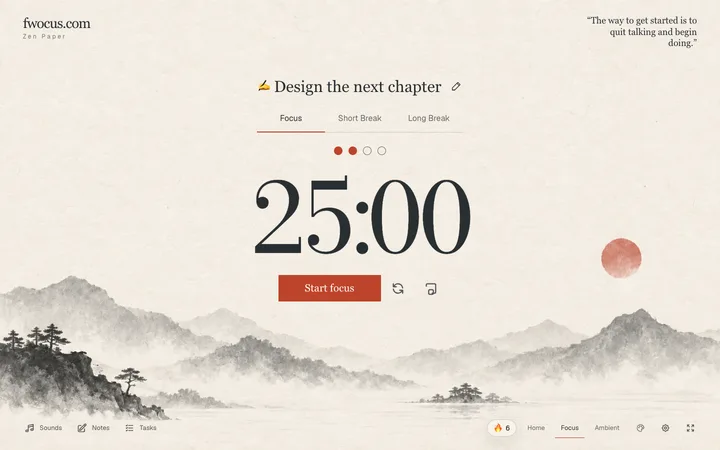
Fullscreen the timer with F and put it on a second display or behind the reading window. The Zen Paper theme keeps it calm when you glance over. Keyboard only: Space to start, L per chapter, Space to stop. No mouse, no fiddling, no decisions.
Phone away is non-negotiable for reading sessions. Not face-down on the desk. Away. A phone in reach is a chapter interrupted every ten minutes, and interrupted chapters are the ones you remember nothing of.
The setup takes thirty seconds and pays for itself in the first session. Friction is the tax on every reading habit. Most failed reading routines are not motivation problems. They are friction problems wearing a motivation costume.
Keys that stay out of the reading
Space starts and pauses. L marks each chapter or sprint boundary. R resets. F toggles fullscreen.
My reading ritual: book open, timer open, F for fullscreen, Space to begin, L at every chapter. The soft chime confirms the lap without pulling my eyes from the page. At the end of the week, the lap list shows pages per hour, honest and earned.
For structured writing routines with fixed sprints and background sound, the Fwocus app adds Pomodoro intervals and ambient soundscapes. The reading timer stays the home of open, unpressured measurement.
FAQ
How do I measure my reading speed?
Time several chapters with the stopwatch, pressing L at each chapter end. Divide pages read by hours elapsed. Three or four chapters give a reliable pages-per-hour figure for that kind of book.
Should I try to read faster once I know my pace?
Pace is diagnostic, not a target. Comprehension comes first; speed follows familiarity with the material. Forcing pace usually costs understanding, which defeats the purpose of reading.
Can I use a reading timer for writing sprints?
Yes. Time the sprint with count-up and count words afterwards. Measuring the session separately from the output keeps you writing for the draft instead of performing for a live counter.
Will timing my reading make it stressful?
Count-up has no alarm and nothing to run out of, so there is nothing to watch. If checking the clock stresses you, fullscreen the timer and look only at chapter boundaries.