Written by Dr. Leo Maren · Co-founder of Fwocus · Behavioural scientist · PhD, Imperial College London
Time blindness meets the countdown alarm
Time blindness is the difficulty of sensing how much time has passed. An hour can feel like ten minutes. Ten minutes can feel like an hour.
A countdown timer adds a second problem on top of the first. Not only is time hard to feel, it is running out. The shrinking number is a threat, and the alarm at the end punishes losing track.
Count-up reverses the direction. The number grows with your effort. It records what you have achieved instead of threatening what remains.
This does not fix time blindness. It changes what the timer asks of you: observation instead of vigilance.
What this timer will not do
This timer is not treatment for ADHD. It will not diagnose, manage, or reduce symptoms. Anyone whose focus problems impair daily life should talk to a clinician.
Externalizing time, making elapsed time visible outside your head, is a widely used strategy in ADHD coaching. The evidence for it is practical rather than clinical: coaches report it helps, and the mechanism is plausible.
Individual response varies. Some people find a visible timer grounding. Others find any timer agitating, count-up included. Both responses are information, not failure.
We make no medical claims for this page. We describe design choices and the reasoning behind them. What helps you is an experiment only you can run.
What we removed, and what we kept
We removed everything that startles. No alarms. No red flashing digits. No ticking sound counting down to a deadline.
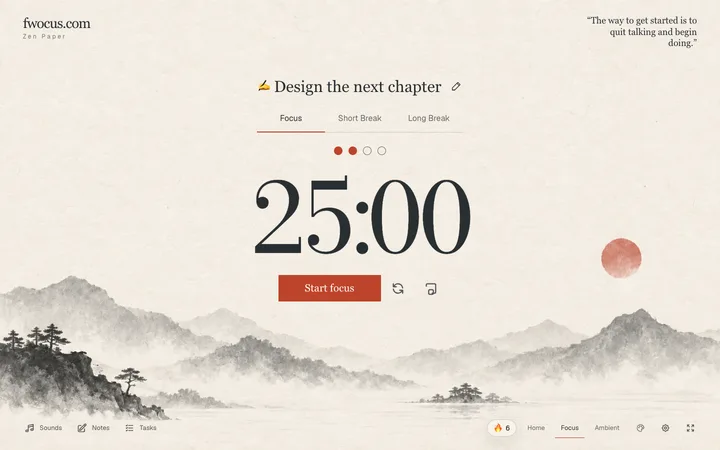
What remains is deliberately quiet. The Zen Paper theme shows large, calm digits on a paper-like background. The only sound is a soft chime that confirms your own actions: start, lap, stop.
The chime never interrupts you. It answers you. That distinction is the whole design.
Press F for fullscreen and the interface disappears almost entirely. Fewer pixels means fewer invitations to look away.
When we tested early versions, several testers described the same moment. They glanced at the timer mid-task, saw 23 minutes, and felt steadier instead of panicked. One said it was the first timer that did not feel like it was waiting for her to fail. We kept that sentence on the wall while we finished the design.
A visible number as an external memory aid
The mechanism is simple. Time tracking is working memory work: you hold when you started in mind while doing the task. For ADHD minds, that background thread keeps dropping.
A growing number on screen holds the thread for you. You do not have to remember when you started. The timer remembers, visibly, the whole time.
This is the same logic behind writing the one task on paper before you start. Get the invisible things out of your head and into the world.
The limit is honest: an external number cannot create motivation and cannot remove distractions. It pairs best with one written task and a phone in another room. The timer handles the time. You handle the rest.
Starting without the dread
Most timers ask for a commitment before you begin: 25 minutes, go. For someone who dreads the session, that commitment is the wall.
This timer asks for nothing. Press Space and start. There is no length to fail at and no alarm to dread.
If you stop after eight minutes, the display shows eight minutes of work. Not a failed session. Eight minutes of work. The reframe matters because shame is a worse focus tool than any timer.
I do not have ADHD, and I will not pretend this page speaks from that experience. What I know is building the tool: we watched people brace themselves before pressing start on countdown timers, shoulders up, jaw tight. Nobody braces before pressing Space here. That absence of bracing is the entire product.
For sessions where gentle background sound helps, the Fwocus app (https://app.fwocus.com/) offers ambient soundscapes. Some people focus better with soft noise; others need silence. Both are fine.
FAQ
How is this different from a Pomodoro timer for ADHD?
A Pomodoro timer counts down to a deadline and ends with an alarm. For time-blind minds that creates threat and dread. This timer counts up with no alarm, so it records effort instead of policing it.
Will this timer help my ADHD?
It may help you track time on task, and many people find externalized time grounding. It is not treatment, and individual response varies. If focus problems impair your daily life, talk to a clinician.
Why are there no alarms or notifications?
Sudden stimuli can spike anxiety and break fragile focus. The only sound is a soft chime confirming your own actions. The timer answers you; it never interrupts you.
What if I keep stopping after a few minutes?
Then your log shows the truth: several short bursts of real work. That is information, not failure. Try one written task at a time, and let the timer show you your actual pattern before changing anything.