Written by Dr. Leo Maren · Co-founder of Fwocus · Behavioural scientist · PhD, Imperial College London
An aesthetic quote is a short line that looks as good as it reads. The look is half of it: the words, the line breaks, the type, and the picture behind them. That is also why aesthetic quotes need more care than other quotes. A beautiful line travels fast, and a wrong name travels with it.
The 35 quotes on this card come from poets and writers, such as Mary Oliver, Rainer Maria Rilke, Matsuo Bashō and Virginia Woolf. They are about attention, nature, quiet and time. None of them tells you to work harder. That is a choice, and the next section explains it.
Why a beautiful quote feels true
People judge a statement as more true when it is easy to read. Psychologists call this processing fluency.
In 1999, Reber and Schwarz showed statements such as "City A is in Country B" in different colors. Statements in colors that were easy to see on the white screen were judged true more often. In 2000, McGlone and Tofighbakhsh gave people unfamiliar sayings in a rhyming form and in a non-rhyming form with the same meaning. People rated the rhyming versions as more accurate. The effect got weaker when people were told to separate the sound of a saying from its meaning.
What this does not show: it does not show that beautiful quotes are false or that you should not enjoy them. These were lab judgments about simple statements and sayings.
What it means for you: a quote on a soft background in elegant type gets a bonus that it did not earn. Enjoy aesthetic quotes for what they do well, which is to set a mood. Be slower to take life advice from one only because it looks right.
I noticed this while we built the card. We tested the same line in plain text and on a scene with a paper card behind it. On the scene, I liked the line more, and I trusted it more. The words had not changed.
Pick quotes that set a mood, not quotes that give orders
This is why the set leans toward observation. Thoreau's "I love a broad margin to my life" does not tell you what to do. It describes a way to feel about time. Woolf's "No need to hurry. No need to sparkle." gives you permission rather than a goal.
For studying, this works better than it sounds. A calm line before a session lowers the stakes of starting. It does not promise a result that you then fail to reach.
My own routine is one aesthetic quote at the start of the day, then a plain aesthetic timer for the work. The quote sets the tone. The timer and the task list carry the pressure.
Credit the translator, not only the poet
More than a third of the quotes here are translations from Japanese, Chinese, German, French, Greek and other languages. A translation is a new piece of writing. Two translators of the same haiku can choose very different English words.
Where we know the translator, the source line on the card names them, such as "trans. Sam Hamill" for Bashō or "trans. Stephen Mitchell" for Rilke. Stephen Mitchell's Laozi line is labeled "interpreted by," because his version is a free rendering, not a close translation.
When you share a translated quote, give both names. "Bashō, trans. Sam Hamill" is correct. "Bashō" alone suggests that he wrote those English words.
Check the name before you post a quote
Many aesthetic quotes on image boards carry the wrong name. A line from an unknown blog gets the name of a famous writer, and the name makes people share it.
When we built this set, we dropped every popular line that we could not trace to a book, a poem, a letter or a speech. Each quote here was checked against a sourced section of English Wikiquote or against the original work. The card shows that source under the author.
To check a quote you found somewhere else:
Search for the exact words with the work, not only the author. A real quote has a title and a year.
Look at where it first appeared. If the only sources are other quote sites and image posts, the attribution is not confirmed.
On Wikiquote, read the section heading. Lines under "Misattributed" or "Disputed" are exactly what you do not want.
Make a quote image that reads well
Download PNG makes a 1080 × 1350 portrait image: the quote on a light paper card over this plum blossom scene, with the author, the source and fwocus.com at the bottom. The image is made in your browser. Nothing is uploaded.
Short quotes make the best images. The card shrinks the type for long quotes, and a 40-word passage becomes small text on a phone. Poems on the card use " / " to mark the poet's line breaks, which is the usual way to quote verse in a single line.
On my own desk, I keep one printed quote card at a time. When I started, I printed six. After a week, I could not have told you what any of them said. One card in a new place each month is easier to notice.
A quote and a session on Plum Blossom
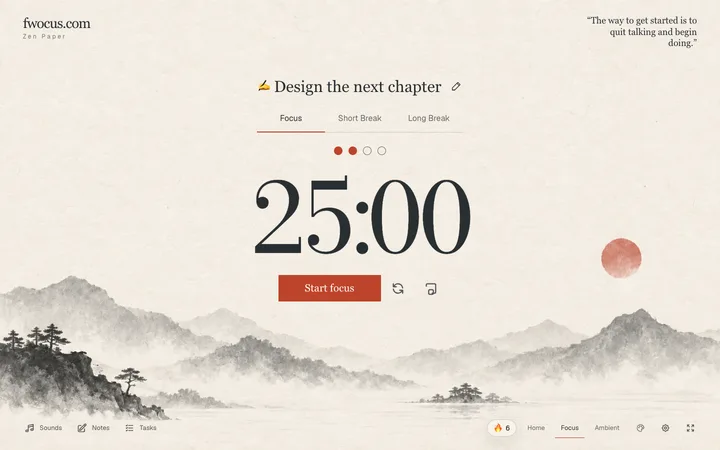
The scene behind the card is Plum Blossom, an ink-wash painting of a plum tree in flower beside misty water. It is one of more than 60 scenes in the Fwocus app. In the app, you can switch scenes, keep tasks and notes next to the timer, and see your focus stats and streak. Start a focus session opens the app from the card.
FAQ
Is there a new aesthetic quote every day?
Yes. The card shows the same quote all day and the next quote after midnight. Use Next quote or the arrow keys to see the others.
Can I use these quotes for captions or posts?
Yes. Click Copy to get the quote with the author and the source, and keep the credit in your caption. Several poets in the set, such as Mary Oliver and Wendell Berry, are modern, so their books are the place to read the full poems.
Why are some quotes split with slashes?
The slash marks a line break in the original poem. It keeps the poet's lines visible when a poem is written as one line of text.
Can I choose the picture behind the quote?
Not on this page. The image always uses the Plum Blossom scene. The Fwocus app has more than 60 scenes to work in.