Written by Dr. Leo Maren · Co-founder of Fwocus · Behavioural scientist · PhD, Imperial College London
Most people wait to feel motivated before they study. In my experience, the order is the other way around. The feeling of motivation usually comes about ten minutes after I start, not before. So this page is not about how to feel like studying. It is about how to start without that feeling.
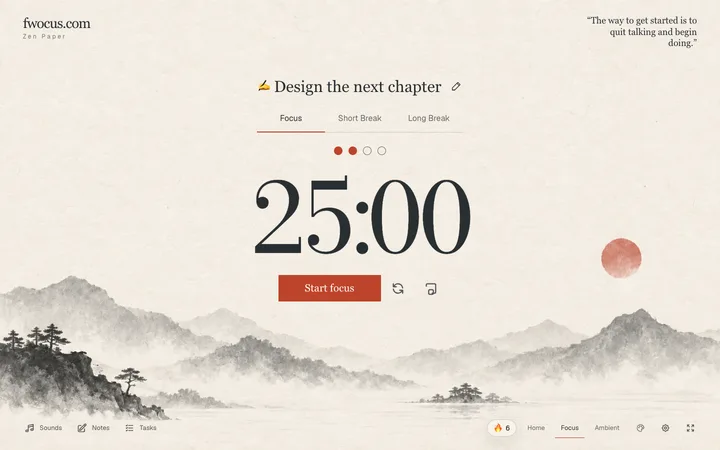
The quote card helps with the first minute. The 31 quotes in this set are about beginning and about small daily work. Horace wrote, "He who has begun has half done." He was exaggerating, but not by much.
Why you put off studying
The best summary of why people delay work is a 2007 meta-analysis by Piers Steel. He combined 691 correlations from studies of procrastination. Four things predicted delay strongly and consistently:
Task aversiveness: the task is boring, hard or unpleasant.
Delay: the deadline or the reward is far away.
Low self-efficacy: you doubt that you can do the task well.
Impulsiveness and distractibility: something easier is always within reach.
One popular explanation did badly: perfectionism had little link to delay. In Steel's data, perfectionists procrastinated slightly less than others, though they worried about it more.
These are correlations across many studies. They do not tell you why you, today, did not open your notes. They do give you a checklist. Each of the four causes has a lever you can pull.
Use one lever for each cause
If the task is unpleasant, make the first step smaller. "Study chemistry" is unpleasant as a whole. "Copy the three equations from slide 12" is barely a task. Choose a first step that takes less than two minutes and needs no decision.
If the deadline is far away, make a near one. An exam in five weeks does not feel urgent today. A 25-minute focus session ends in 25 minutes. The short block turns a distant deadline into a close one.
If you doubt you can do it, start with the part you can do. Do the easy question first, or rewrite the notes you already understand. Early success is information that you can do the task.
If something easier is always in reach, move it. Put the phone in another room before you press start, not when you notice it.
When I wrote my thesis, the chapter I avoided most was the statistics chapter. I was sure I would get the analysis wrong. That was a self-efficacy problem, not a laziness problem. What worked was a rule: the first session of the day was only for checking the output of yesterday's analysis. It was a task I could not fail. By the time it ended, I was already inside the chapter.
You are avoiding a feeling, not the work
Fuschia Sirois and Timothy Pychyl argue that procrastination is mostly about mood. In their 2013 review, they describe it as a way to repair a bad mood now, with the cost paid later by your "future self." You do not avoid the essay. You avoid the dread you feel when you open it.
This is a theory paper, not a new experiment. But it matches what I see in myself. The urge to check something else is strongest in the first minute of a session. It is much weaker in minute fifteen.
What this means in practice: you do not need to remove the bad feeling before you start. You need to make the first step so small that the feeling is small too. Then the feeling fades while you work.
A two-minute start with the quote card
This is the routine the card is built for:
Read today's quote. If it does not fit your day, click Next quote once or twice. Do not browse.
Write your first step on paper. One line, one physical action: "Open the lab report and write the heading."
Click Start a focus session. It opens the Fwocus app with a timer.
Promise yourself only the first ten minutes. If you want to stop after ten minutes, stop. Most days you will not want to.
Anthony Trollope's line in this set says it well: "A small daily task, if it be really daily, will beat the labours of a spasmodic Hercules." The ten-minute promise makes the task small enough to be daily.
If you prefer a fixed short block with no app, the 10-minute timer does the same job. If you hate being stopped once you are going, the Flowmodoro timer lets you work until you stop and then sets your break.
Study inspiration can replace studying
Study vlogs, desk tours and aesthetic study photos feel like preparation. They show you what studying could look like. They do not move your own work forward.
I used to watch one study video "to get in the mood" before a session. One video became three. I now use a hard rule: inspiration only after a session, never before. The quote card is short on purpose. It takes ten seconds to read, and then the button is right below it.
When low motivation is telling you something
Sometimes the problem is not starting. If you cannot start the same task for many days, check three things:
The goal is unclear. You do not know what "done" looks like. Ask your teacher what a good answer contains.
The task is too big. Break it into steps until each one fits in one session.
The subject is not yours. If you avoid every task in one course, talk to an advisor or tutor about it. Better tactics do not fix a wrong fit.
A greenhouse in the rain
The scene behind the card is Greenhouse Morning: a glass greenhouse in the rain, with lanterns, potted plants and a wet stone floor. It is one of more than 60 scenes in the Fwocus app. In the app, you can switch scenes, save sessions, keep tasks and notes next to the timer, and see your focus stats and streak.
FAQ
What does Start a focus session do?
It opens the Fwocus app in a new tab, where you can start a timer with a task. This page itself has no timer.
Does the quote change every day?
Yes. The card shows the same quote all day and the next one after midnight. You can move through all 31 with the arrows.
Can I save a quote?
Click Copy for the text with its author and source, or Download PNG for an image of the quote on this greenhouse scene. The image is made in your browser and nothing is uploaded.
Where do the quotes come from?
Each quote was checked against a sourced section of English Wikiquote or a primary source, such as the book or letter it comes from. The source shows under the author's name on the card.