Written by Dr. Leo Maren · Co-founder of Fwocus · Behavioural scientist · PhD, Imperial College London
Count-up timing fits work you bill after the fact
A countdown assumes you know how long something takes. Billable work almost never does.
A stopwatch records time as it passes. It does not estimate and it does not negotiate.
That neutrality is the point. When the session ends, the total is simply what you worked.
A phone timer demands a preset duration before you begin. A stopwatch starts with one keystroke and stops when the work stops. The tool gets out of the way.
Clients can sense the difference. An invoice built from measured time reads differently from one built from rounded memory. The line items are specific. The totals are odd numbers. Odd numbers are believable.
Rounding is where invoices lose their honesty
Most professional services bill in six-minute increments, tenths of an hour. The common habit is to round each entry up. A seven-minute task becomes 0.2 hours. Twenty such entries quietly manufacture an hour that was never worked.
In my early consulting years I billed in fifteen-minute blocks, always rounded up. A six-minute email became a quarter hour. No client ever questioned it. I questioned it every month, usually at 2 a.m.
When I switched to a count-up stopwatch and logged exact durations, my invoices fell by roughly twelve percent. Two clients noticed the change and renewed at higher rates. Precision turned out to be a better business strategy than padding.
Round the day's total, not each entry. The stopwatch gives you exact figures. What you do with them is a policy you can defend in writing.
This is also a legal distinction in some jurisdictions. Inflated time entries on a client invoice are a liability. Exact logs are a defense.
Use laps to split one session into line items
Press L whenever the task changes. Each lap becomes a line on the invoice: research, drafting, calls, revisions.
On a recent research contract I lapped by phase instead of keeping one running total. Literature review, analysis, writing, review. When the client asked for a breakdown, I had one ready. Each phase carried its own measured time.
The discipline matters more than the tool. Lapping takes one second. Reconstructing the day from memory takes twenty minutes and produces fiction.
Pause with Space when you step away. The clock stops, and so does the billing. The entire ethics policy fits in one keystroke.
At the end of the week, the lap log becomes a map of where your hours went. Mine once showed that quick calls consumed eleven percent of my billable week. I started batching them the following Monday.
Write your pause rules before you start the clock
Thinking time is work. Staring at the ceiling while a problem turns over counts, and you should bill it. Lunch, errands, and personal calls do not count.
The gray zone is interruptions. My rule: pause for anything longer than two minutes. Shorter than that is the normal friction of a workday and stays on the clock.
I once let the clock run through lunch to compensate for a slow morning. The stopwatch made the padding visible in a way memory never did. I wrote the rule down that evening and have followed it since.
Decide the rules once. The stopwatch then enforces whatever honesty you encoded into them.
Note the distinction between availability and work. Being reachable is not the same as working. If a client pays for availability, say so in the agreement. Do not smuggle it into hourly entries.
Shortcuts and a daily closing ritual
Space starts and pauses the timer. L marks a lap for the next invoice line. R resets when the day is done. F opens fullscreen, keeping the clock visible and the temptation to fudge out of sight.
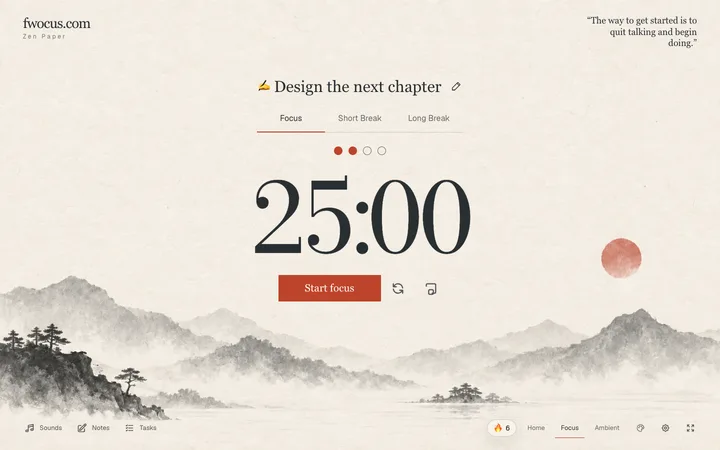
The Zen Paper theme keeps the display calm and readable from across a desk. The subtle Zen audio chime marks each lap, so you can log task changes without looking at the screen.
My closing ritual takes ninety seconds. Stop the clock, read the total, write each lap time into the time log while the numbers are fresh. Tomorrow's invoice is already half written.
For structured sessions like Pomodoro intervals or fixed-length sprints, the Fwocus app (https://app.fwocus.com/) handles the countdown side. The stopwatch handles everything a countdown cannot measure: the work that simply took the time it took.
FAQ
Should I round billable time up or log it exactly?
Log it exactly, then round once at the end. Rounding each entry up compounds quietly: twenty small round-ups can manufacture an hour that was never worked. Rounding the day's total to the nearest tenth is standard, defensible, and honest.
Does a stopwatch help with fixed-fee projects too?
Yes. Divide the fee by the hours the stopwatch recorded and you get your true hourly rate. That number tells you whether to raise the fee, narrow the scope, or decline the next project like it.
How should I handle interruptions while the clock is running?
Decide the rule before you start. A workable default: pause for anything over two minutes, keep the clock running for shorter friction. Thinking time counts as work. Lunch, errands, and personal calls do not.
Why is count-up better than a countdown for tracking work?
A countdown assumes you know the duration in advance. Billable work rarely cooperates. Count-up records what actually happened, which is the only figure an invoice should be built on.