Written by Dr. Leo Maren · Co-founder of Fwocus · Behavioural scientist · PhD, Imperial College London
A bell you are waiting for is a bell you cannot ignore
Set a twenty-minute countdown and the last five minutes belong to the timer. Part of your attention stands guard, listening for the bell.
That guard duty is the opposite of meditation. The practice asks for open, unguarded attention. Awaiting an alarm keeps one thread of the mind permanently occupied.
A stopwatch removes the appointment. There is no bell coming. Nothing to listen for. The guard can stand down.
I meditated with a twenty-minute countdown for over a year. Every session ended the same way: five minutes of clock-watching disguised as practice. The timer was not supporting the sit. It was taking it over, minute by minute.
This is the anticipation effect: a known future event captures attention in the present. Meditators call it waiting mind. A stopwatch has no event to wait for, so the mind has nothing to rehearse.
Let the sit set its own length
Some days twelve minutes is a complete sit. Some days the mind settles slowly and thirty-five minutes feels right. A fixed timer treats both days the same. They are not the same.
Count-up lets the session end when it ends. You sit until the sitting feels complete, then you look at the time. The number is information, not a grade.
With the stopwatch, my sits settled into a natural range: fourteen minutes on busy days, thirty or more on quiet ones. Both felt complete. Under the countdown, every sit felt either too long or too short.
Set a soft minimum if you need structure: ten minutes, say. The minimum gets you onto the cushion. After that, the sit decides.
Beginners often worry they will sit for three minutes and quit. In practice the opposite happens: without a finish line to fixate on, most people sit longer than they planned. The cushion is more comfortable than the clock.
Duration is not the score
A daily ten-minute sit beats a weekly sixty-minute sit. Consistency builds the habit. Length builds the story you tell about the habit.
The stopwatch can tempt you to chase numbers. Resist it. A longer sit is not a better sit. Some of the most useful sits are short ones on difficult days.
I once strung together a month of forty-minute sits and felt accomplished. Then I noticed I was dreading the cushion and skipping days. I dropped to fifteen minutes daily and the practice survived. The streak mattered more than the length.
The exception: structured practice like retreats or courses uses fixed sits, and that is fine. A countdown serves a curriculum. A stopwatch serves a personal practice. Use each where it belongs. The Fwocus app (https://app.fwocus.com/) handles the structured side.
If you teach or share the practice, model this. New meditators copy what they see measured. Measure consistency and they will value showing up. Measure minutes and they will value endurance.
Review the log without judgment
Write down each sit's length. Not to compete with yourself, but to notice patterns.
My log showed something I did not expect: my shortest sits clustered before my hardest weeks. The days I most needed the practice were the days I gave it the least time. The pattern was invisible until the numbers made it visible.
Review weekly, lightly. Look for the relationship between sit length and the texture of your days. The log is a mirror, not a leaderboard.
If the log shows skipped days, shorten the minimum rather than scolding yourself. Five minutes daily survives. Twenty minutes aspirationally does not.
One more pattern worth watching: sits that feel terrible often precede the clearest days. The log plus a one-word note, restless, calm, dull, turns the record into a genuine instrument.
Shortcuts and a sitting ritual
Space starts and stops. R resets for tomorrow. F opens fullscreen, which turns the display into a calm, single-purpose object with nothing to fiddle with.
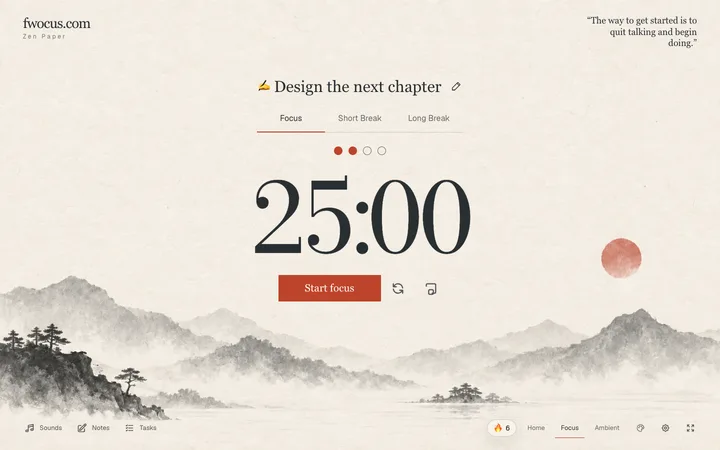
The Zen Paper theme suits the practice: quiet, high-contrast, unhurried. There is no progress bar, no ring closing, no streak flame. Just the time, passing.
My ritual: cushion, timer started with Space, eyes closed. When the sit feels complete, I open my eyes, stop the timer, and write the number in the log before standing. Ninety seconds of bookkeeping closes the session cleanly.
The subtle Zen audio chime can mark the start of a sit with a lap press. The ending needs no announcement. You will know.
FAQ
Shouldn't a meditation timer end the session with a bell?
For structured sits, yes: a bell has its place. For open personal practice, an expected bell keeps part of your attention on guard, listening for it. A stopwatch removes the appointment and lets attention rest fully.
How long should I meditate?
Start with a soft minimum of ten minutes daily. Let individual sits run as long as they feel complete. Consistency matters far more than any single session's length.
Won't I just quit after three minutes without a timer keeping me there?
In practice the opposite happens. Without a finish line to fixate on, most people sit longer than planned. If you need structure, keep a ten-minute minimum and let the rest be open.
Should I track how long I meditate?
Log the length and a one-word note on quality. Review weekly for patterns: many people discover their shortest sits precede their hardest weeks. The log is a mirror, not a leaderboard.