Written by Dr. Leo Maren · Co-founder of Fwocus · Behavioural scientist · PhD, Imperial College London
Read this first: the safety rules are the article
Never practice breath-holding alone. Never practice in water. These two rules prevent nearly every serious accident in this discipline.
Shallow-water blackout is real and it is silent. Hyperventilation before a hold suppresses the urge to breathe without adding meaningful oxygen, which lets consciousness slip away without warning.
Practice dry, seated or lying down, with someone nearby who knows what you are doing. Stop at strong discomfort. There is no number worth a blackout.
Everything below assumes these rules. If any of them feel optional, stop reading and come back when they do not.
A final note on scope: this page covers dry static practice for general comfort and CO2 tolerance. It is not freediving instruction. If you want to take holds into water, learn from a certified instructor, in person.
The urge to breathe is a signal, not a limit
The urge to breathe comes from rising carbon dioxide, not from falling oxygen. Your body warns you about CO2 long before oxygen becomes a problem.
Beginners misread the first urge as the limit. It is not the limit. It is the first notification. Trained holders feel diaphragmatic contractions for a minute or more and remain entirely safe.
This distinction changes practice. You are not fighting suffocation. You are learning to sit calmly with a strong sensation. The skill is relaxation under signal, not endurance against danger.
I spent my first month trying to beat the urge by force of will. My times stalled at ninety seconds and every hold felt like a fight. When a freediving coach reframed the urge as information rather than threat, my holds lengthened within two weeks. Nothing physical changed. The interpretation did.
An honest caveat from my own practice: the research on long-term benefits of casual breath-hold training is thinner than enthusiasts claim. I practice it for the relaxation skill, which transfers everywhere. Treat bigger claims with skepticism.
Count-up keeps the practice relaxed, and relaxed is the whole game
A countdown to a target time creates pressure. Pressure creates tension. Tension burns oxygen. The target defeats itself.
Count-up removes the target. You hold until the hold feels complete, then you look at the number. The result is information, not a verdict.
This matters because the limiting factor in static holds is relaxation, not lung capacity. A calm holder with average lungs outlasts a tense holder with large ones. Every technique in this discipline is a relaxation technique wearing a different name.
My best holds happened on days I forgot to care about the number. The stopwatch suits that state: it asks nothing of you while you hold, and it remembers everything afterward.
There is a paradox worth naming: the holds that improve fastest are the ones where improvement is not the goal. Attention on the number tightens the body. Attention on relaxation loosens it, and the number follows.
Progressive practice in small, boring steps
The standard structure is simple: two minutes of relaxed breathing, one comfortable hold, then rest for twice the hold time. Repeat three to four times.
Never hyperventilate to extend a hold. Fast deep breathing blows off CO2, which silences the urge while oxygen keeps falling. That is the mechanism behind shallow-water blackout. Breathe normally, or slightly slower than normal.
Extend holds by ten to fifteen seconds per week, not per session. CO2 tolerance builds gradually. The diaphragm contractions will arrive later and feel milder. That is the adaptation, and it cannot be rushed.
End every session with an easy hold, well within your comfort. The last thing the nervous system should learn is that holds end calmly. Finish relaxed and the next session starts relaxed.
Track three numbers per session: breathe-up time, hold time, and a one-word state note. Over weeks you will see which states produce the best holds. For most people it is bored. Bored is excellent.
Shortcuts and a rounds ritual
Space starts and stops. L marks the end of the breathe-up and the start of the hold if you want both numbers. R resets between rounds. F opens fullscreen for a display you can read while lying down.
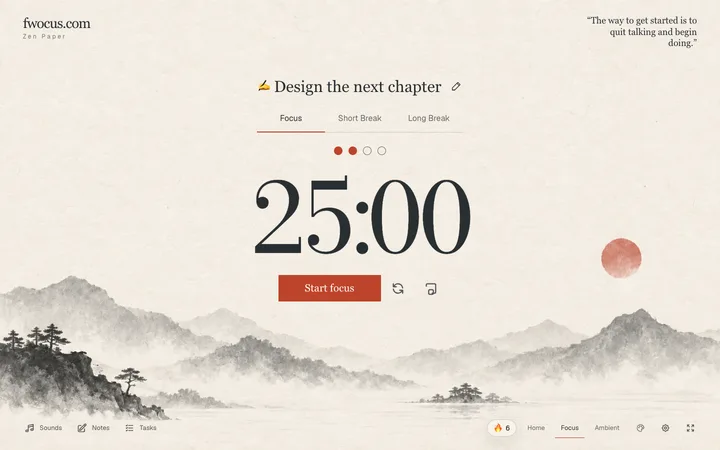
The Zen Paper theme is calm at a glance, which matters when you check the time mid-hold. The subtle Zen audio chime marks transitions without startling you out of relaxation.
My ritual: seated, back supported, phone face-up where I can see it without moving my head. Breathe-up timed, hold timed, rest timed. Same sequence every session. The routine holds the structure so the mind can let go.
For formal CO2 and O2 tables with fixed intervals, the Fwocus app (https://app.fwocus.com/) runs structured countdown rounds. The stopwatch is for relaxed maximum attempts, where the absence of a target is the technique.
FAQ
Is breath-hold training safe?
Dry practice is low-risk if you follow the rules: never alone, never in water, never hyperventilate before a hold, and stop at strong discomfort. Shallow-water blackout happens because hyperventilation silences the urge to breathe, so the urge is your safety system and you never bypass it.
Why do I feel the urge to breathe so early?
The urge is driven by rising carbon dioxide, not falling oxygen. Your body signals CO2 buildup long before oxygen becomes a problem. Learning to sit calmly with that sensation, rather than fighting it, is the core skill.
Should I set a countdown to a target time?
No. A target creates pressure, pressure creates tension, and tension burns oxygen. Count-up records the hold without demanding anything during it, which keeps the body relaxed. Relaxation is what extends holds.
How do I improve my breath-hold time?
Practice consistently with relaxed breathing, comfortable holds, and rest twice as long as each hold. Add ten to fifteen seconds per week. CO2 tolerance builds gradually and cannot be rushed.