Written by Dr. Leo Maren · Co-founder of Fwocus · Behavioural scientist · PhD, Imperial College London
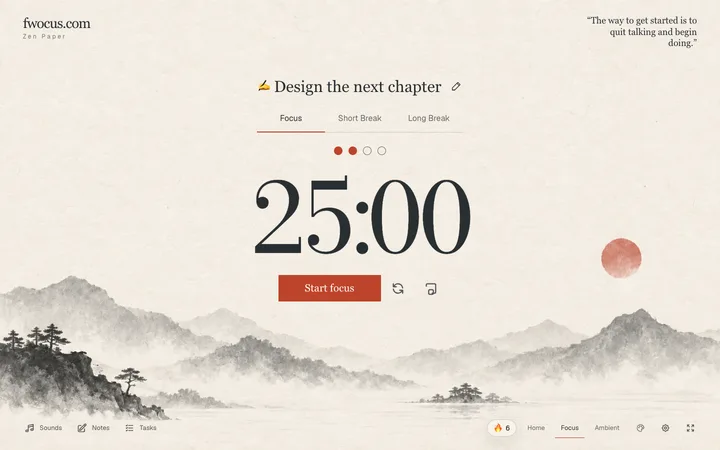
Press Space to start. At zero, a singing-bowl chime plays, the digits pulse, and "Time's up" appears. Press R to set the same minute again.
In a one-minute session, a slow start costs a large part of the time. I keep one hand on the keyboard, not the mouse. The minute then starts at the moment I decide to act.
Use the timer to test the one-minute rule
The one-minute rule comes from the writer Gretchen Rubin. Her version: if a task can be done in one minute or less, do it now. Her examples include hanging up a coat, filing a paper, and replying to a quick text.
The rule depends on one estimate: the task really takes a minute. The timer checks that estimate.
When I first tried the rule, I applied it to my inbox. Many replies that I called "quick" ran past the chime. A reply that needs a decision is not a one-minute task, even when the reply is one line long.
Now I use the chime as a test, not as a deadline. If the task is not finished at zero, I stop and put it on my list. This keeps a set of small tasks from taking over a whole morning.
Rubin also sets a limit. The rule does not help with tasks that are difficult, emotionally charged, or long. It clears small clutter. It does not fix the avoidance of hard work.
For hard work, a longer first step is more useful. The 10 minute timer uses the ten-minute rule: commit to ten minutes, then decide. The 2 minute timer covers the two-minute rule for new habits.
One-minute speaking drills
A minute of speech is long enough to show where you hesitate. It is also short enough to repeat ten times in a row.
The BBC Radio 4 game Just a Minute has used this length since 1967. Players speak for sixty seconds on a given subject. The rules forbid hesitation, repetition, and deviation from the subject.
Toastmasters uses a similar range for Table Topics, its impromptu speaking exercise. In its guidance for Table Topics, the green card goes up at one minute. The yellow card follows at 1:30 and the red card at two minutes.
In Table Topics, one minute is the minimum, not the target. Practice until you can reach the chime with one clear point. Then press +1 min before you start and practice the full two minutes.
A simple drill:
Write a topic on the task line above the timer.
Start the timer and speak until the chime without a stop.
Speak on the same topic again and remove the filler words.
I used this drill before conference talks during my PhD at Imperial. My first attempts ran out of material early. I made my point in about 40 seconds and then said it again in other words.
The fix was a structure: one claim, one example, one consequence. That structure fills a minute without padding. For timing a full talk, use the speech timer.
A minute of slow breathing is a reset, not a full session
One minute gives you time for about five or six slow breaths. That is a useful pause. It is shorter than the sessions that research has tested.
A 2018 systematic review by Zaccaro and colleagues defined slow breathing as fewer than 10 breaths per minute. It included 15 studies of healthy adults. Slow breathing was linked to higher heart rate variability and to reports of more relaxation and less anxiety.
What it does not show: that one minute is enough. The single sessions in the review lasted 5 to 20 minutes, and some studies used many days of training. The authors also noted that methods differed too much for a meta-analysis.
I use one minute of slow breathing before I open a difficult email. I count about five breaths, each with a longer out-breath. I do not claim that this changes my physiology in 60 seconds. It does stop me from replying in the first minute after I read the email, and that has prevented some bad replies.
If you want a practice closer to the studies, use the 3 minute timer for the three-minute breathing space, or the 5 minute timer. Breath holds are a different exercise: use the breath-hold timer for those.
Keep a one-minute timer on screen
Space starts and pauses. R resets to the chosen length. The Up arrow adds a minute and the Down arrow removes one. F opens fullscreen, which helps when a class or group watches the same minute.
In a background tab, the time stays correct, but the browser can delay the end sound. A short delay does not matter for the one-minute rule. It matters in a timed speaking round.
While we tested this page, I ran the timer in a background tab and the chime arrived late once. Since then, I keep the timer visible for any drill where the exact end matters.
FAQ
Is the 1 minute timer exactly 60 seconds?
Yes. It counts down from 1:00 to 0:00. The browser tab also shows the time left while the timer runs.
Can I set the timer to 30 or 90 seconds?
No. This page changes the length in whole minutes only. For 30 or 90 seconds, use the simple stopwatch and stop at the time you need.
Does the timer make a sound at the end?
Yes. A soft tone plays at the start and a singing-bowl chime plays at zero. For a timer with no sound at all, use the silent timer.
Do I need an account?
No. The timer is free and needs no account or installation. It does not save your task line or your sessions.