Written by Dr. Leo Maren · Co-founder of Fwocus · Behavioural scientist · PhD, Imperial College London
Seventy-five minutes is not a random number. It is the standard length of many US college classes and many high school block periods. It is also the World Health Organization's minimum weekly dose of vigorous exercise. Most people who set this timer are doing one of those two things.
I first used a 75-minute countdown to teach, not to work. The first time I ran a 75-minute workshop, I planned it like a 50-minute lecture with more slides. By minute 40, half the room was looking at their phones. The timer showed me where my plan broke. The plan was the problem, not the length.
Why so many classes last 75 minutes
In US higher education, one credit hour usually means 50 minutes of class time a week. A three-credit course therefore needs 150 minutes a week. Schools meet it in two common ways: three 50-minute classes on Monday, Wednesday and Friday, or two 75-minute classes on Tuesday and Thursday. The University of Iowa registrar lists the "Tuesday/Thursday, 75-minute" pattern as one of its standard options, and many universities use the same split.
Many high schools use block schedules with periods of about 75 to 90 minutes. The school takes fewer, longer periods in place of seven or eight short ones.
Does a longer period make students learn more? The evidence says: not clearly. Zepeda and Mayers (2006) reviewed 58 studies of high school block scheduling. Grades and school climate often improved. The effects on standardized test scores and attendance were inconsistent. They also found that teachers said they needed training to teach in a long block.
That last point matches my experience. A 75-minute period helps only when the lesson uses the extra time for something a 50-minute period cannot hold.
Plan a 75-minute class in parts, not as one lecture
You have probably heard that attention drops after 10 to 15 minutes of a lecture. The evidence for that exact number is weak. Bradbury (2016) looked back at the studies behind the claim. He found no good primary data for a fixed 10- to 15-minute limit. The largest difference in student attention came from the teacher, not from the format.
So do not cut the block into 10-minute pieces because a rule says so. Cut it because different activities need different amounts of time. This is the split I now use for a 75-minute session:
0–10 min: a warm-up problem or a recall question from last time.
10–35 min: the new idea, taught directly, with a short check halfway through.
35–60 min: students apply the idea in pairs or small groups.
60–70 min: one or two groups show their work, and I correct errors.
70–75 min: an exit question and a clear next step.
I project the timer so that the room can see the time left. Students stop asking "how long is left?" and I stop drifting past my plan. When the applied part runs long, I press − during the session to cut five minutes from the discussion. The class still ends on time.
Students on a Tuesday/Thursday schedule face a gap of four or five days between some classes. That gap is long enough to forget much of the material.
One 75-minute review block on the day between classes helps. Do not spend it rereading notes. Spend it on retrieval: close the notes, write what you remember, then check. Dunlosky et al. (2013) rated this kind of practice testing as one of only two high-utility study methods, and 75 minutes gives you time for two full rounds.
My own rule for a 75-minute study block is simple. I write one outcome on the task line before I press Start, for example "Solve problem set 4, questions 1–6." A block with a clear outcome ends with a result. A block called "study statistics" usually ends with a clean desk.
If 75 minutes is too long for you right now, start with the 50 minute timer and its 10-minute break. If you need a longer single block, use the 90 minute timer.
75 minutes of vigorous activity a week
The WHO 2020 guidelines (Bull et al., British Journal of Sports Medicine) advise adults to do at least 150–300 minutes of moderate aerobic activity a week, or at least 75–150 minutes of vigorous activity, or a mix of both.
"Vigorous" has a practical test. The CDC says that during vigorous activity you cannot say more than a few words without a pause for breath. Running, fast cycling, swimming laps and singles tennis usually qualify. If you can talk in full sentences, the activity is moderate, and the 75-minute target does not apply to it.
Can you do all 75 minutes in one session? The guideline is a weekly total. The 2020 update also removed the old rule that activity had to come in bouts of at least 10 minutes. Total volume is what counts.
There is also direct evidence for one or two sessions a week. O'Donovan et al. (2017) studied "weekend warriors" in English and Scottish health surveys. These adults met the guideline in one or two sessions a week. They had a lower risk of death from all causes than inactive adults, with a hazard ratio of 0.70. Adults who spread the same amount over more days had similar results.
This is observational data. It shows an association, not proof that the pattern caused the lower risk. What it does suggest is that a busy week with one long session is much better than no session at all.
I use this timer for my longest run of the week. I do not run hard for 75 minutes. I set the timer, warm up at an easy pace, and count only the hard parts toward the weekly total. On most weeks, that one session gives me around 40 vigorous minutes. The rest comes from two shorter runs.
A safety note: 75 minutes of vigorous exercise in one session is a big jump for someone who is inactive. Build up over several weeks. If you have a heart condition, chest pain on effort, or another medical condition, talk to a doctor first.
How this 75 minute timer works
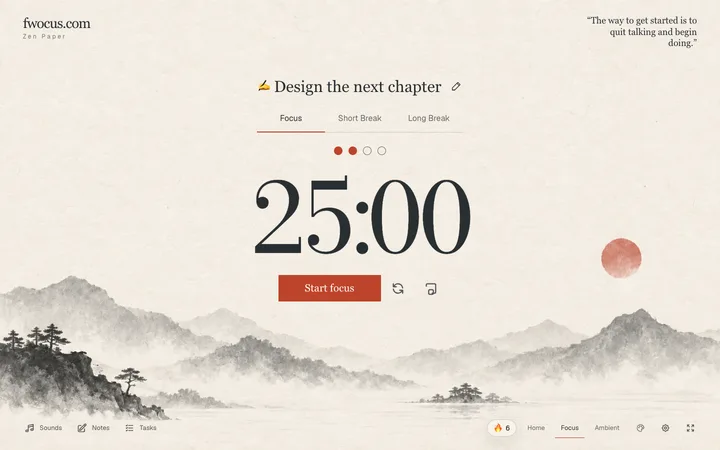
Press Start or Space to begin. The button changes to Pause, then Resume. Press R to reset to 1:15:00 and F for fullscreen, which is useful on a classroom projector.
The − and + buttons, or the Down and Up arrow keys, change the length by one minute. They work before and during a session. The browser tab shows the time left, so you can switch to slides or notes and still see it.
At zero, a soft singing-bowl chime plays once. The sound follows your device volume, and some phones mute web audio in silent mode. For a workout where you will not look at the screen, the loud timer is easier to hear.
On supported browsers, the screen stays awake while the timer runs. Nothing is saved, and you do not need an account. The timer has no interval beeps, so it does not mark the parts of a lesson or a workout for you. The Fwocus app adds backgrounds, ambient sounds, focus stats and streaks.
FAQ
How long is 75 minutes in hours?
Seventy-five minutes is 1 hour and 15 minutes, or 1.25 hours. If you start at 9:00, the timer ends at 10:15.
Is 75 minutes too long to focus?
For most adults, 75 minutes of focus on one planned task is realistic, but attention does not stay flat for the whole block. A clear outcome and a change of activity partway through help more than a strict rule about attention spans, which the evidence does not support.
Should I take a break during a 75-minute block?
A short stand-up break of a few minutes is fine and does not break the block. Press Space to pause, then press it again to resume. If you want a scheduled break, the break timer is built for it.
Does one 75-minute workout meet the weekly WHO guideline?
It meets the vigorous-activity minimum only if all 75 minutes are at vigorous intensity, which is hard for most people. Moderate minutes count at a lower rate, since the moderate target is 150 minutes. WHO also advises muscle-strengthening activity on two or more days a week.