Written by Dr. Leo Maren · Co-founder of Fwocus · Behavioural scientist · PhD, Imperial College London
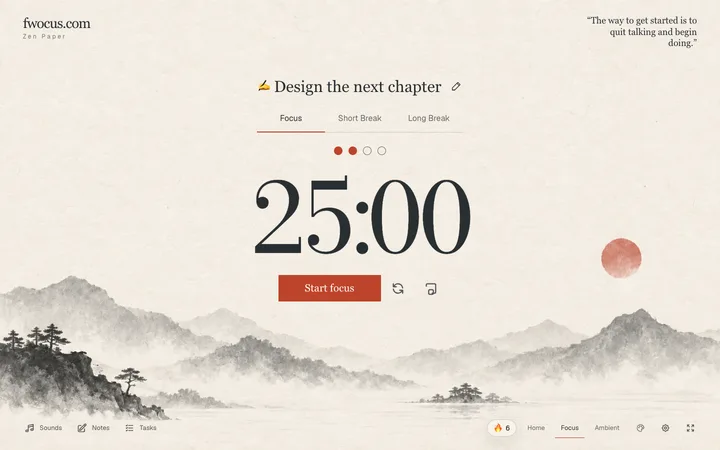
Press Start or Space, and the timer counts down from 45:00. At zero, a singing-bowl chime plays, the digits pulse, and "Time's up" appears. Press R to reset to 45 minutes.
Forty-five minutes is the standard lesson length in German schools, and many class periods elsewhere are close to it. Many students and teachers already know how that length feels. That makes it an easy block to plan around.
Why a school lesson is 45 minutes long
The 45-minute lesson was a scheduling decision, not a discovery about attention. On August 22, 1911, the Prussian minister of culture ruled that all lessons in Prussia's higher schools must last 45 minutes. The German Historical Museum describes the background.
Before the reform, lessons lasted 60 minutes, with teaching in the morning and the afternoon. Psychologists of the time measured student fatigue. They recommended about 30 minutes for young children, 45 to 50 minutes for older students, and longer breaks as the day went on.
The reform took the shorter lesson but not the longer breaks. Breaks became shorter so that all 30 to 32 weekly lessons fit into the morning. Afternoon lessons ended. Some teachers protested that 45 minutes was not enough time for a sensible lesson.
I like this history because it removes some false authority from the number. Forty-five minutes is a reasonable length for focused study. It is not a proven attention limit. And the part the psychologists cared about most, the break, was the part that was cut.
Attention does not collapse after 10 minutes
A popular claim says that students lose attention after 10 to 15 minutes. If that were true, a 45-minute block would be a bad idea. The evidence for the claim is weak.
In a 2016 review in Advances in Physiology Education, Bradbury traced the claim to its sources. He found few primary studies, and many of them had weak methods. The most cited source barely discussed student attention at all.
His conclusion: the data do not support a 10- to 15-minute attention limit. The largest differences in attention came from differences between teachers, not from the lecture format.
For a 45-minute block, this means the length alone rarely decides whether you stay focused. The task decides more. When I read a dense chapter passively, I lose the thread after about 20 minutes. When I work problems from the same chapter, I stay with it for the full 45.
So when a 45-minute block goes badly, I change the task before I shorten the block. I close the book, write the main points from memory, and then check them against the text.
How to run a 45/15 study hour
The 45/15 rhythm is 45 minutes of study and a 15-minute break. It repeats every clock hour, so it is easy to track. Start on the hour, and stop at a quarter to.
This page times the 45 minutes. For the break, use the 15 minute timer or the break timer. Nothing starts by itself, so you decide when each part begins.
During my PhD, I used 45/15 on library days. The fixed hour made planning easy. I could meet a colleague for coffee at a quarter to the hour without breaking a block.
Two mistakes are common. The first is a break that grows to 30 minutes. The second is a break spent on the phone, which often ends with a new worry to carry into the next block. I start the break timer before I stand up, and I leave the phone on the desk.
After three or four rounds, take a longer stop. The 1911 psychologists wanted longer breaks later in the day. My experience agrees with them. My fourth block of the afternoon is rarely as good as my first block of the morning.
Use a short check-in inside the block
Some people find 45 minutes too long without any pause. There is a middle way: a planned check-in of a few seconds, not a break.
Ariga and Lleras (2011) gave 84 participants a repetitive 50-minute computer task. Most groups got worse over time. One group switched briefly to a second task twice during the session. That group kept a steady performance.
The task was a simple vigilance test, not study. The result does not prove that check-ins help with reading or problem sets. But it fits what I notice: a brief look at my goal brings me back to the task.
I use the task line for this. When the timer passes 22 minutes left, I read the task line again and ask one question. Is this still the thing I wrote down?
Use the timer for a class period
Teachers can project the timer for a lesson or an in-class task. Press F for fullscreen. On supported browsers, the screen stays awake while the timer runs.
Set the timer to end before the bell. Press −1 min or the Down arrow five times to get 40 minutes and leave time to pack up.
If the chime would disturb the room, use the silent timer. It ends with pulsing digits and no sound. For a test with a fixed length, the exam timer has presets from 30 minutes to 3 hours.
Controls, and what this page does not save
Space starts, pauses, and resumes the timer. The −1 min and +1 min buttons, or the Down and Up arrows, change the time before or during a session. The browser tab shows the time left while the timer runs.
In a background tab, the time stays correct, but the browser can delay the chime. Click the task line to type your topic. The page does not save your task or your sessions. The Fwocus app keeps focus stats and streaks.
FAQ
Is 45 minutes too long to study without a break?
For most study tasks, no. The evidence does not support a fixed 10- to 15-minute attention limit. If you often drift, change to a more active task, or try the 25 minute timer for a while.
Does the timer start the 15-minute break by itself?