Written by Dr. Leo Maren · Co-founder of Fwocus · Behavioural scientist · PhD, Imperial College London
Eighteen minutes is the most famous time limit in public speaking. TEDx talks must end by 18 minutes, a limit that comes from TED. The official TEDx speaker guide is direct about it: you cannot go over 18 minutes, because then "it wouldn't be a TEDx Talk."
The same guide gives the rehearsal advice that this page is for: "Practice with the clock winding down in front of you. Do it until you get the timing right every time." A countdown does this better than a stopwatch. You see the time you have left, not the time you have used.
Why TED chose 18 minutes
TED's own answer is short. The TEDx speaker guide says: "Because it works. An audience is good at focusing on one subject at a time in relatively short chunks." TED curator Chris Anderson has explained the limit in interviews in a similar way. He describes 18 minutes as long enough to say something serious and short enough to hold attention, also online.
This is a design decision, not a scientific limit. You will often read that attention in a talk drops after ten minutes. Wilson and Korn (2007) checked the studies behind that claim for lectures. They found the evidence for a fixed 10- to 15-minute attention span weak. Attention changes with the speaker, the content and the listener, not only with the clock.
So the value of 18 minutes is not in the number itself. The value is that a hard limit forces you to cut. The TEDx guide adds a point that many speakers ignore: "Shorter talks are not lesser talks."
Rehearse to 16 minutes, not 18
I gave an 18-minute talk at a public science evening in London, in a format modeled on TED. At home, my rehearsals ended at 17:40. On the night, I finished at 19:10, and the host had to wave at me. The audience laughed at two points, and I waited for the laughs. I also added examples when I saw confused faces. None of that happens in your living room.
From that talk, I took a simple rule: a talk that fits 18 minutes on stage fits about 16 minutes in rehearsal. Your number can differ. Measure it once: record one rehearsal, and compare it with the length of the real talk later.
Use the timer like this:
First run: find the real length. Press Space and give the whole talk without stopping. If the chime sounds before you finish, note where you are. That is how much you must cut.
Cut whole parts, not words. Speaking faster does not fix a long talk. It makes it harder to follow. Remove one full example or one full section.
Set checkpoints. Write the time left at each section start in your notes, for example "Story at 15:00, data at 10:00, ending at 3:00." Then check them in each rehearsal.
Rehearse to 16 minutes. Press − twice before you start, and rehearse to a 16-minute countdown. The two extra minutes on stage are your margin.
Practice the ending alone. The last two minutes carry the idea people remember. Rehearse them more often than the rest.
Press F for fullscreen, and put the screen where you would see a confidence monitor on stage. The TEDx guide tells speakers to rehearse on stage with the confidence monitor, the screen in front of the speaker, so practice the look down and back up.
What 18 minutes holds
Word count helps you plan before you rehearse. My own talks run at about 130 to 140 words per minute when I speak slowly enough for a room. At that rate, 18 minutes is about 2,300 to 2,500 words, and 16 minutes is about 2,100 to 2,200. Count your script, divide by your own rate, and you know the size of the cut before your first run.
The second common use of an 18 minute timer is the GRE. Since the shorter GRE started on September 22, 2023, the first Verbal Reasoning section has 12 questions in 18 minutes. The second Verbal section has 15 questions in 23 minutes.
Twelve questions in 18 minutes gives you 90 seconds per question on average. Reading comprehension questions take longer than sentence-level questions, so do not spend the same time on each. A simple checkpoint: be at about question 6 when the timer shows 9:00.
The first section matters more than its length suggests. ETS uses section-level adaptation: your result in the first Verbal section sets the difficulty of the second. So practice section 1 under real time, not with the clock paused. For the second section, use the 23 minute timer. For Quantitative Reasoning section 1, use the 21 minute timer. For full practice tests, the exam timer is the better tool.
Timer controls
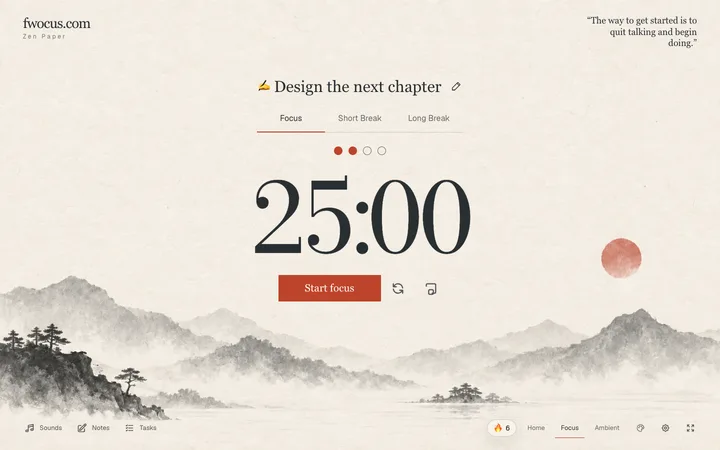
Press Space to start, pause and resume. Press R to reset to 18:00. Press F for fullscreen. The − and + buttons, or the Down and Up arrow keys, change the length by one minute, before or during a session.
The default sound is one soft chime at zero. In a rehearsal, that chime is your "time's up" from the host. If you need silence to record your rehearsal, choose the silent timer instead. The browser tab shows the time left, and on supported browsers the screen stays awake while the timer runs. The task line above the digits is editable but not saved.
FAQ
Do TED talks have to be exactly 18 minutes?
No, 18 minutes is the maximum, not the target. The TEDx speaker guide says you cannot go over 18 minutes, and it also says that shorter talks are not lesser talks.
Is there scientific proof that 18 minutes is the best length for a talk?
No, there is no study that shows 18 minutes is the best length. TED explains it as a limit that works for audiences, and research on lectures does not support a fixed 10- or 15-minute attention span either.
How many GRE Verbal questions are in 18 minutes?
The first GRE Verbal Reasoning section has 12 questions in 18 minutes, which is 90 seconds per question on average. The second Verbal section has 15 questions in 23 minutes.