Written by Dr. Leo Maren · Co-founder of Fwocus · Behavioural scientist · PhD, Imperial College London
Most people who search for a 5 second timer need one of two things. They need a short limit for a game, or they want to use a countdown to make themselves start something. The timer does the first job well. For the second job, the evidence is thinner than the popular advice suggests.
Use it as a replacement for a lost game timer
Many party games use a five-second limit. In the card game 5 Second Rule, a player must name three things in a category, such as three dog breeds, before a small spiral timer runs out. The spiral timer is easy to lose. This page does the same job, and every player can hear the chime.
Some tips from our own game nights:
Put the timer where everyone can see it. Press F for fullscreen. The digits then fill the screen of a laptop or a tablet on the table.
Choose the right sound. The default chime is soft. In a loud room, use the loud timer instead, which plays a sharp beep alarm.
Let the reader press Start. The person who reads the card presses Space as they finish the last word. This keeps the start fair.
Press R between turns. R resets the timer to five seconds, and Space starts the next turn.
When I tested this page with friends, five seconds was harder than we expected. Most players named two things and froze on the third. We tried a house rule where the + button adds 5 seconds for younger players. A 10-second turn made the game fair for my eight-year-old niece, and the adults kept 5. If your group wants that change, the 10 second timer opens at 10 seconds.
Five seconds is also the limit in some sports rules. In basketball, a player who throws the ball in from out of bounds has five seconds to release it. The timer is useful for practice drills. It is not a replacement for an official game clock.
What the 5 Second Rule claims
Mel Robbins made the "5 Second Rule" popular in her 2011 TEDx talk and her 2017 book. The method is simple. When you feel an impulse to act on a goal, you count backward 5-4-3-2-1. Then you move before your mind talks you out of it. Her book page says the rule is "backed by research" and uses "the science of habits."
I tried the rule during my PhD, mainly to get out of bed and to open a draft I did not want to read. It helped with the bed. It helped less with the draft. The count got me to open the file, but I still sat and looked at it. The count solved the first physical movement, not the thinking that came after it.
What the evidence shows and does not show
I could not find a peer-reviewed study that tests the 5 Second Rule itself. The book relies mainly on stories from readers. Stories show that the rule helps some people. They do not show how many people it helps, or whether the countdown is the part that does the work.
The problem the rule targets is real. Psychologists call it the intention-behavior gap. A review by Sheeran and Webb (2016) shows that people often fail to act on intentions they hold. A common failure point is the start: people miss the moment to act, or they hesitate when the moment comes.
A countdown gives a clear moment to act. That is a reasonable explanation for why the rule helps some people. It is my interpretation, not a tested result. Claims that counting backward "activates the prefrontal cortex" or "breaks the habit loop" go beyond what any published test of the rule has shown.
What this means in practice:
Use the countdown for actions that take one movement, such as standing up, sending an email, or making a phone call.
Do not expect it to fix a task that is unclear. If you do not know the first step, five seconds of counting will not create one.
If the rule works for you, keep it. It costs nothing and has no known harm.
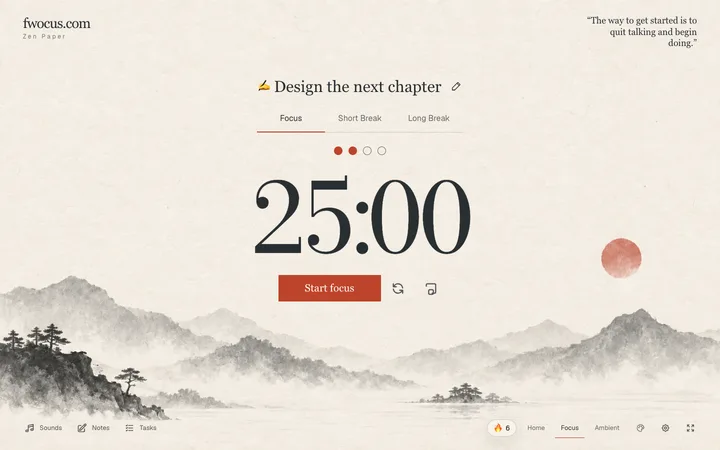
You do not need a timer for the Robbins method. She counts in her head. A visible timer helps when you want an external signal. I use it when I sit down to write. I type the first action in the task line, press Start, and put my hands on the keyboard before the chime.
The other "5 second rule": dropped food
The food version is a separate claim. It says food is safe to eat if you pick it up within five seconds. Miranda and Schaffner (2016), at Rutgers University, tested this claim. They dropped four foods onto four surfaces and measured bacterial transfer at contact times from under one second to five minutes.
Bacteria moved to the food in under one second in some tests. Longer contact did transfer more bacteria. But the type of food and the type of surface mattered as much or more. Wet watermelon collected the most bacteria. Carpet transferred less than tile or stainless steel. As Schaffner said in the Rutgers summary, bacteria "can contaminate instantaneously." A timer cannot make dropped food safe.
Short times and a real-world delay
A five-second countdown is short enough that small delays matter. The time between your decision and your finger on the button is often half a second or more. For games, this does not matter because every player has the same delay. For timing that must be exact, use a keyboard: Space reacts faster than a mouse click on a small button.
When we built the short timers, we had to choose the end sound carefully. The default singing-bowl chime rings for a few seconds. On a five-second timer, the chime is almost as long as the countdown. We kept it because it is clear without being harsh. If you play many quick rounds, the silent option lets you watch the digits and skip the sound.
Timer controls
Press Space to start, pause, and resume. Press R to reset to five seconds. Press F for fullscreen. The − and + buttons, or the Down and Up arrow keys, change the length by 5 seconds before or during a countdown. The browser tab shows the time left while the timer runs.
The timer runs in your browser. It is free, needs no account, and saves nothing. The task line above the digits is editable, but it is not saved when you reload. Sound follows your device volume, and some phones mute web audio in silent mode.
For longer starts, a 2 minute timer fits the two-minute rule, which makes a new habit small enough to begin. The 1 minute timer suits a one-minute challenge.
FAQ
Can I make this timer loop for many rounds?
No. The timer stops at zero and waits. Press R and then Space to start the next five seconds, which takes one second with the keyboard.
Is the 5 Second Rule scientifically proven?
No. We found no peer-reviewed study that tests the rule directly. The problem it targets, the gap between an intention and an action, is well documented, and a countdown gives a clear moment to act, but that explanation is an interpretation and not a tested result.
How do I set a timer for 5 seconds without a phone?
Open this page on any computer or tablet and press Space. The countdown starts at five seconds and plays a chime at zero, and no app or account is necessary.
Why is there no sound on my phone?
Some phones mute web audio when the ring switch or silent mode is on. Turn silent mode off and check the media volume, or use fullscreen so players can see the digits reach zero.