Written by Dr. Leo Maren · Co-founder of Fwocus · Behavioural scientist · PhD, Imperial College London
Rest is the set you cannot see, so it gets skipped
Nobody cuts a working set short to feel productive. Everybody cuts rest short. The bar is racked, the phone comes out, and ninety seconds later you are under the bar again, having rested for forty.
A countdown does not fix this. You set three minutes, get impatient at ninety seconds, and stop the timer early. The tool cannot enforce what you will not.
Count-up changes the dynamic. The clock records the rest you actually took. There is no timer to stop early, only a number that tells the truth.
I thought I rested two minutes between heavy sets for an entire training block. When I started the stopwatch out of curiosity, the average was seventy seconds. My lifts had stalled for six weeks. The rest was the flaw, not the program.
The mechanism is simple: short rest on heavy sets reduces the load you can handle, which reduces the training stimulus, which stalls progress. Skipped rest does not save time. It wastes the set.
Minimum rest depends on what the set was for
Strength work needs two to five minutes. The phosphagen system that powers heavy lifts takes about three to five minutes to fully replenish. Short rest on heavy sets is not toughness. It is a lighter set in disguise.
Hypertrophy work needs sixty to one hundred and twenty seconds. The goal is incomplete recovery: enough to perform, not enough to feel fresh. Metabolic stress is part of the stimulus.
Endurance and conditioning work needs thirty seconds or less. The short rest is the training.
Match the rest to the goal before the session starts. Write the minimum next to each exercise. When the stopwatch passes it, you may lift. Not before.
These are minimums, not targets. Resting longer than the minimum is fine when the set demands it. Resting shorter is the error to watch for.
Measure the rest you actually take
Planned rest and actual rest are different numbers. Planned rest is what your program says. Actual rest is what the stopwatch says. Only one of them affects your training.
Start the timer when the set ends. Stop it when the next set begins. Do this for one full session and compare against your program. Most lifters find a gap.
After discovering my seventy-second habit, I enforced a strict two and a half minutes on squat days. The weight that had stalled for six weeks moved in two. Nothing else changed. Not the program, not the diet, not the sleep. The rest.
Log rest alongside the sets: weight, reps, rest taken. Patterns emerge. If performance drops in later sets, check whether rest drifted shorter as the session wore on.
One exception: supersets and paired exercises deliberately use short rest. That is programmed, not skipped. The stopwatch still helps. It keeps the programmed short rest from drifting even shorter.
Too much rest has a cost as well
Rest is not free. Past five minutes on most exercises, the body cools down, the heart rate settles, and focus drifts. The next set starts cold.
Long rests also inflate session length. A workout with five-minute rests between every set can run past ninety minutes. Fatigue from duration replaces fatigue from effort, and the quality of later sets falls.
Use laps to keep rest honest in both directions. L at the end of each set, L when the next begins. The lap times show every rest interval. If one ran to seven minutes because of a conversation, you will see it.
When rest must be long, on true maximal strength work, stay warm. Pace, shake out, rehearse the next set mentally. Idle standing is not rest. It is cooling down.
A practical ceiling: if rest passes five minutes, do a warm-up set before the work set. The body forgot some of what the earlier sets taught it.
Shortcuts and a session ritual
Space starts and stops. L marks the end of a set and the start of the next. R resets between exercises. F opens fullscreen so the time is readable from across the gym floor.
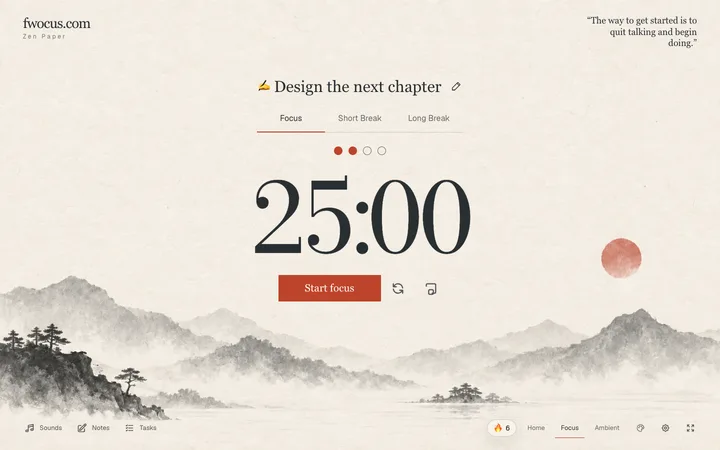
The Zen Paper theme stays readable under harsh gym lighting. The subtle Zen audio chime marks each lap, so you can time rest without staring at the screen.
My ritual: the timer starts when the bar is racked and stops when my hands touch the bar again. No phone during rest. The rest interval is part of the training, so it gets the same attention as the set.
For fixed rest periods in circuit training or timed supersets, the Fwocus app (https://app.fwocus.com/) runs structured countdown intervals. The stopwatch is for the days when rest is a minimum to respect, not a limit to hit.
FAQ
How long should I rest between sets?
Two to five minutes for heavy strength work, sixty to one hundred twenty seconds for hypertrophy, thirty seconds or less for endurance. These are minimums: resting longer is fine, resting shorter undermines the set.
Why count up instead of using a countdown for rest?
A countdown can be stopped early the moment you feel impatient. A stopwatch records the rest you actually took, which enforces the minimum without relying on willpower.
Should I rest longer on heavy compound lifts?
Yes. Squats, deadlifts, and presses draw on the phosphagen system, which needs three to five minutes for full recovery. Short rest on these lifts quietly turns them into lighter sets.
How do I keep track of sets and rest periods?
Press L at the end of each set and again when the next begins. The lap times give you a complete record of work and rest to review after the session.