Written by Dr. Leo Maren · Co-founder of Fwocus · Behavioural scientist · PhD, Imperial College London
A sprint timer should serve the words, not shout at them
A writing sprint is a short burst with a single job: produce raw text. A countdown turns that burst into a race against an alarm. A stopwatch turns it into a measurement of your real pace.
I ran 25-minute countdown sprints for a year while drafting my thesis chapters. I hit the word targets, but the last five minutes of every sprint were frantic, and the frantic pages needed the most rewriting. Speed bought at the end of a countdown is usually paid for in the edit.
Count-up changed the dynamic. I sprinted until the words ran dry, lapped the sprint with L, and noted the word count. Over a month I learned my honest drafting pace, which turned out to be slower and far more sustainable than the alarm had demanded.
Match the sprint length to the draft stage
Outlining, drafting, and editing run at different cadences, and one sprint length does not fit all three. Outlining sprints can be short, fifteen to twenty minutes, because decisions are quick. Drafting sprints run longer, thirty to forty-five minutes, because momentum needs time to build.
Editing is the exception. It looks like writing but behaves like reading: slower, more deliberate, and badly served by sprint pressure. I do not sprint my edits at all. I time them with a plain stopwatch and no lap targets, because the goal is judgment, not volume.
The mistake is treating every writing task as a production task. Ask before each sprint what this session is actually for. If the answer is words on the page, sprint. If the answer is thinking, slow down and let the timer simply witness.
Measure output, not just minutes
Minutes are cheap to log and easy to misread. A ninety-minute session that produced two hundred words was not a ninety-minute writing session. Pair the timer with a word count and the picture gets honest.
Lap each sprint and record the words beside the time. After a few weeks you will see your curve. Most writers hold a steady words-per-hour for the first two or three sprints, then the line bends downward. That bend is your real limit for the day. Pushing past it produces text you will delete tomorrow.
This is where my experience disagreed with the standard advice. The productivity literature loves the long daily session. My lap data disagreed: my fourth sprint consistently produced half the words of my first at twice the effort. Three sprints and a walk now outproduce four sprints and a slump. Your curve will differ; the point is to find it.
End sprints on a sentence, not on an alarm
Hemingway famously stopped writing mid-sentence so he would know where to start the next day. The mechanism is real: an unfinished thought pulls you back to the desk, while a finished one lets you drift. A countdown makes this hard, because the alarm decides the stopping point.
With count-up, you choose. When the energy dips, finish the thought you are on, leave the next one half-formed, lap the sprint, and stop. Tomorrow starts with a live wire instead of a blank page. I have kept this habit for years, and the mornings I ignore it are measurably slower to start.
There is a subtlety. Do not stretch a dying sprint just to reach a round number of minutes. The timer is a witness, not a quota. Stopping at 34 honest minutes beats grinding to 45 hollow ones.
Shortcuts and the sprint ritual
Space starts and pauses, L laps each sprint, R resets, and F gives you a fullscreen view with nothing to fiddle with. Eliminating screen friction matters more for writers than for anyone: every settings panel is an excuse not to write.
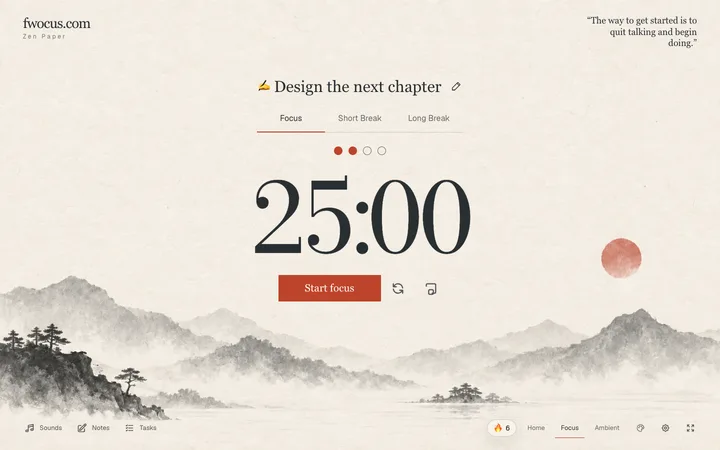
The Zen Paper theme keeps the timer visually quiet while you work. My ritual is fixed. Close everything except the document. Fullscreen the timer on a second view, write the sprint's single goal at the top of the page, then press Space. Ninety seconds of setup, then words.
For days when you want structured intervals instead of open sprints, the Fwocus app offers Pomodoro rounds. I keep both in the toolkit: count-up sprints for drafting days, fixed intervals for admin-heavy days. The writing decides the tool.
FAQ
How long should a writing sprint be?
Long enough for momentum, short enough to stay sharp: 25 to 45 minutes for drafting, 15 to 20 for outlining. Skip sprinting for editing entirely. Let your own lap data set the length, when words-per-sprint bends downward, that is your limit.
Should I set a word-count target for each sprint?
Record the count, but do not chase it mid-sprint. A target turns the timer into a quota and the last minutes into frantic filler. Log words per sprint for a few weeks, learn your honest pace, and let the average guide your planning instead.
Is a countdown better for short sprints?
A countdown adds urgency that helps with procrastination but hurts drafting quality. The final minutes get rushed and need rewriting. If starting is your problem, use a countdown for the first week. Once the habit exists, switch to count-up and measure output instead.
What do I do when a sprint produces almost nothing?
Lap it, log the low count, and move on without judgment. One dead sprint is noise; three in a row is a signal to change the task, the time of day, or the draft stage. The data is only useful if you keep collecting it on bad days too.