Written by Dr. Leo Maren · Co-founder of Fwocus · Behavioural scientist · PhD, Imperial College London
Research has no finish line, so measure the investment
A literature review does not end. It stops when you decide you know enough. A countdown cannot time that decision, because there is no moment it should ring. A stopwatch can, because it shows what the search has cost so far.
Early in my PhD I spent entire days "doing the literature" with nothing to show but browser tabs. The days felt productive and the notes file stayed empty. When I started timing research sessions with a stopwatch, the illusion broke within a week: six hours of reading had produced eleven lines of notes.
That gap between felt work and captured work is the central problem of research time. Count-up timing makes the investment visible. Once it is visible, you can manage it.
One lap per paper
Start the timer when you open a paper and press L when you close it. Write one line in your notes: what this paper claims and whether you believe it. The lap is the unit; the note is the receipt.
Twenty to thirty minutes per paper is a working default for a first pass. If a paper deserves more, it earns a second lap later, deliberately. What you are preventing is the default mode of research reading: forty-five unexamined minutes that end with "interesting" and no notes.
I now run literature sessions as lap sequences, and the discipline compounds. A two-hour session yields four to six lapped papers with notes, instead of a haze of half-read PDFs. The notes are short because the lap forces a verdict. A verdict is what reading is for.
Separate hunting from reading
Searching for papers feels like research, but it is a different activity with a different failure mode. Hunting has no natural end; there is always one more citation, one more keyword. Reading ends when the paper is done. Mixing the two means the hunting never ends and the reading never starts.
Time them separately. Run a hunting block with the stopwatch, collect candidates, and stop when the block's intention is met, say, twelve candidate papers. Then run a reading block and work the list. The timer enforces the boundary that curiosity will not.
This is the trade-off most researchers get wrong. Breadth feels safe because it postpones judgment. Depth feels risky because it commits you to a position. The timer does not resolve the trade-off. It makes each side accountable: hunting laps show how long the search took, and reading laps show what the search produced.
Let the timer hold the rabbit holes
Every good paper cites three tempting ones. Following them immediately is how a focused session becomes a lost afternoon. The rule I use: lap the current paper, write the citation in a holding list, and keep going. The rabbit hole gets its own lap later or not at all.
The mechanism is simple. An interrupted task stays active in memory and pulls at your attention; writing it down discharges the pull. The lap marks the clean break. I keep the holding list next to the timer, and reviewing it at the session's end takes five minutes. Most entries turn out not to deserve a lap at all, which is itself useful information.
Note-taking blocks work the same way. When synthesis calls mid-reading, lap the paper and give the note its own timed block. Reading and writing use different mental gears. The timer keeps them from grinding against each other.
Shortcuts and the research ritual
Space starts and pauses, L laps each paper, R resets between sessions, and F opens a fullscreen view that keeps the timer present but quiet. Your hands learn the sequence in a day; the discipline takes a few weeks.
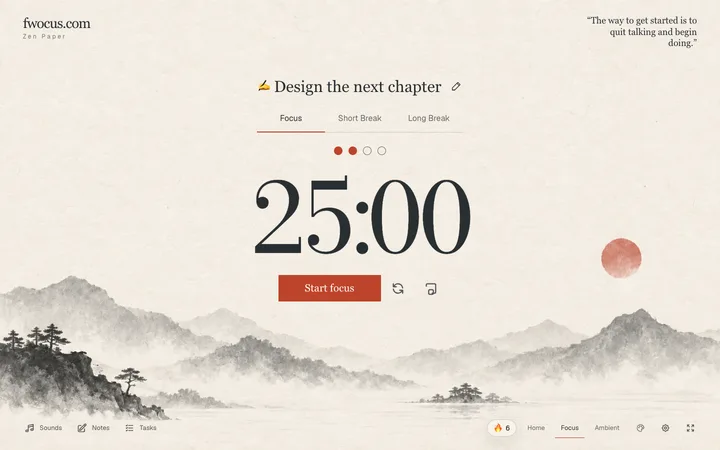
My ritual: define the session's intention in one line, hunting or reading, never both, open the Zen Paper theme, press Space. The calm display matters here because research sessions are long, and a loud timer becomes something you resent by hour two.
For structured reading routines, the Fwocus app offers timed interval options alongside its ambient soundscapes. I use count-up for open literature work and fixed intervals for the mechanical parts, like screening abstracts. Each mode gets the tool that fits.
FAQ
How long should a literature review session be?
Ninety minutes to two hours of reading, broken into one lap per paper. Beyond two hours, verdicts get sloppy and notes get vague. Run hunting and reading as separate sessions. Never mix them in one block.
What if a paper needs more than thirty minutes?
Give it a second lap deliberately, not by drift. Lap the first pass, note what remains unclear, and decide whether the paper earns more time. Important papers deserve deep reading; most papers deserve a verdict and a move-on.
Should I time note-taking separately from reading?
Yes. Reading and synthesis use different mental gears, and mixing them produces shallow notes and interrupted reading. Lap the paper when you close it, then give the note its own timed block. Short, separate, deliberate.
How do I stop falling down citation rabbit holes?
Lap the current paper, write the tempting citation in a holding list, and keep reading. Review the list at the session's end, most entries will not deserve a lap. The written list discharges the mental pull of the unfinished detour.